

AI-Driven Communication: Exploring Effectiveness of AI-Generated Educational Advertisement on Facebook
Akriti[1]
Dr Harinath Kumar[2]
Abstract
The way learning institutions develop and deliver ads has been transformed by the introduction of another functionality of using Artificial Intelligence (AI) in online marketing. Communication has not been the only area that the AI has disrupted, but it has transformed the same especially within the digital marketingand advertisement industry. This change is seen in the fact that AI is being used exponentially in the creation and delivery of educational advertisements, in the production and interaction customization (PV & Aazmi, 2025). The paper discusses the effectiveness of educational adverts developed by AI in Facebook with regards to the level of engagement by audience.The suggested study is premised on the mixed-method approach, as this will entail quantitative data (user engagement indicators) (user click-through, user impressions and user conversions) and qualitative outcomes (user feedback and user sentiment analysis). The proposed research is directed towards the investigation of the effectiveness of AI- Generated Educational Advertisements on Facebook. The effectiveness of communication will also be determined through the systematic analysis of AI-generated advertising based on tone, interactivity, and audience response (likes, comments, shares) analysed with the help of content analysis method and coded and interpreted. The paper is obsessed with the conclusion, depending on the fact whether the AI-generated content of the ads can be as efficient oreffective as the ones created by humans. The findings will illuminate the magnitude to which AI-based ad will characterize interest of the users, curiosity of learning, and intentions to venture into the education industry. The scholarly and practice community is also contributed to in the paper since it represents a factual content ofthe redefinition of AI-based digital communication strategies. The proposed study will enable the educational marketing and policymakers and AI developers to be aware of the possibilities andlimitations of introducing AI creativity to social media advertising.
Keywords: Artificial Intelligence, Educational Marketing, Facebook Advertising, AI-Generated Content, Digital Communication, Audience Engagement, Social Media Marketing, Advertisement Effectivene
Introduction
The increased pace at which artificial intelligence is being developed has changed digital communication, especially in learning and advertising. Social media sites like Facebook are busy scrambling to incorporate AI tools that can arguably create more appealing and informative promotional data that can be customized by the users. With numerous learning institutions competing on the digital platform, the artificial-intelligence-developed advertisement has opened up new opportunities in the relevance and consumer interest’s element. There is also concern when it comes to their overall quality of performance in that there are concerns raised concerning their impressiveness and efficiency as compared to the traditional material produced by humans. The article under consideration is dedicated to the power of online education advertising on Facebook, the anthropological factor, and the ultimate performance of Internet marketing in the educational sector and refers to the potential benefits and the emergent challenges of the system of online communication of AI. Another lesson that can be learned during this conversation is the tendency to find the balance between automation and authenticity since technological efficiency is not to blindly override emotional appeal, ethical responsibility, and trust toward users when it comes to educational promotions. AI-generated advertisements could create an emotional distance unwillingly in their highly polished form. It implies that the hybrid approach, i.e., the effectiveness of AI and the personalisation of the latter combined with the emotional aspect of the creative human methodology of communication, could be the most productive communicative strategy.The rapid growth of digital media has transformed the way audiences consume information, interact with content, and engage with online advertisements. Educational advertising, in particular, has shifted from traditional formats to digital platforms where visuals, short videos, and AI-generated content play a major role in attracting learners. With increasing dependence on social media, understanding how audiences respond through likes, comments, shares, and sentiment has become essential for evaluating the effectiveness of online content.
This study examines audience engagement and sentiment toward educational or AI-driven digital content to understand how users perceive its usefulness, clarity, and overall value. By analysing engagement indicators and public reactions, the research aims to identify factors that shape audience acceptance and to provide meaningful insights for content creators, educators, and policymakers working in digital communication.
Problem of the study
Despite the increasing application of AI-generated adverts in the education sector, there is no evidence of whether these adverts actually work or not compared to the ones created by humans. The paper discusses the ways in which Facebook advert using AI can be quite interesting, build trust and make better decisions regarding learning compared to the common forms of marketing.
Aim and Objective of the study
Aim of the study is to know the effectiveness of AI-generated advertisements on Facebook. This paper have two objectives:
- To understand the effectiveness of AI-generated educational advertisements on Facebook.
- To analyse effectiveness of AI-generated educational ads on Facebook in terms of audience interactivity/ engagement (likes, shares, comments and sentiments of comment).
Literature of review
This is because the more artificial intelligence is implanted in online marketing, the more it has transformed the manner in which learning institutions interact with their prospective students. The newest study indicates that advertising, supported by AI, results in enhanced personalization, precision of the target, and the overall performance on a campaign. According to Huh, Nelson, and Russell (2023), the ability of AI to personalize messages is more probable to attract users and make messages more relevant. Research conducted by PV and Aazmi (2025) also reveals that generated images and copywriting applications using AI allow institutions to produce content at a great rate without any consistency in producing material and creativity. According to Nguyen et al. (2024), in order to render the AI-generated content similar to the one created by the human, it is essential to contrast their responses in terms of audience-level reaction, in particular, the trust and message interpretation.
The study of social media marketing also shows that social media networks like Facebook are reaping the benefits of AI-based optimization, which makes them experience higher levels of click-through, higher strategies of reach, and tighter budgets. According to the author, predictive AI can be used to improve educational campaigns depending on the analysis of the patterns and user behavior in real time (Albakry et al., 2025). The problem of authenticity and emotional attachment remains, however, since, Baek, Kim, and Kim (2024) suggest that users may question the legitimacy of the messages created by the AI, especially in situations where the identity of the AI is disclosed. The experiments carried out by Ali (2025) demonstrate the variation in the stylistic characteristics of AI generated and human generated images and prompts the issue about the tendencies in aesthetic preferences and emotion. Overall, the existing literature suggests that in spite of the significant advantages of AI in terms of performance and personalisation, trust and emotional appeal are the most important factors of user acceptance in educational advertising.
Theoretical Framework
Technology Acceptance Model is a theory that attempts the likelihood of an individual or organization successfully adopting a new system of technology. Developed by Fred Davis in the 1980s.This theory helped explain user’s actual engagement through likes, shares, comments and sentiments with these AI-based advertisements.
Limitations of the study
Only educational advertisements of Facebook was selected for the study. Only AI-generated advertisements used for the study. Only forty five days have selected for sampling period.
Research methodology
Research Design
The study design is a mixed-method study by the fact that it sought to provide a comprehensive study on the usefulness of AI-generated educational ads on Facebook. This approach also enabled the possibility to capture both measurable indicators of performance, but also more qualitative data, which fits the overall academic requirement of multidimensional AI-based advertising assessment as emphasized by Huh, Nelson, and Russell (2023). The present study is used exploratory research design. The researcher have used a content analysis method to collect data in order to fulfils research objectives. The research employed content analysis in an attempt to systematically analyze the tone and the interactivity/engagement employed by each of the advertisements. Coded responses of the audience including likes, comments, shares and sentiment, were applied to understand the effectiveness of AI-generated advertisement on the degree of engagement level of effectiveness.
Sample and Sampling Technique
Broad area/universe: the researcher used study the Content of educational advertisements on Facebook constituted the sample universe ofthe study.
Sampling technique: Purposive sampling method has followed in this study.
Sample: Facebook has selected as sample of the study because of, it is one of the most popular SNSs Worldwide with 1.71 billion active users (Chao and Keung, 2017). Only educational advertisement from government organisation (Ministry of Education official page) on Facebook has been taken.
Sampling period:Forty dayshave purposively selected as sampling Period to analyse the content of educational advertisements.
Sampling technique: Purposive sampling method has followed in this study
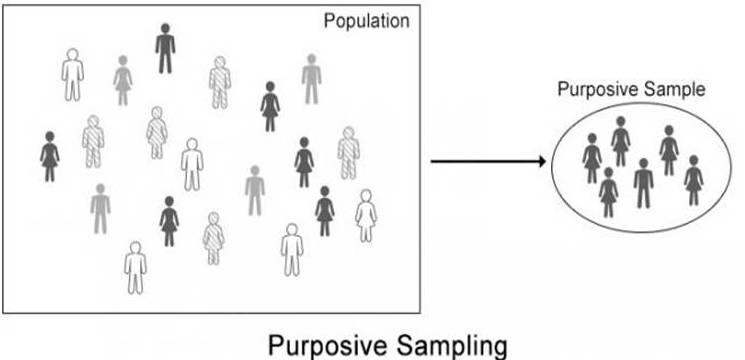
Source: https://research-methodology.net/sampling-in-primary-data-collection/purposive-sampling
Sample size: only 20 educational advertisements were used purposively.
| Educational Advertisements | No. of Advertisements |
|
Youth Empowerment |
5 |
| Awareness Campaign | 5 |
| Educational Campaign | 5 |
| Admission promotion | 5 |
| Total |
20 |
Tools of Data Collection
Content analysis were used as data collection tool to analyze the advertising effectiveness on Facebook. Content analysis is used to identify specific characteristic of messages in a systematic and objective manner, it helps variable extract meaningful like tone and engagement (Holsti, 1969).
Hive moderation application used for detect the advertisements AI-generated. A 2024 independent research study found that Al-generated detection model outperforms competing models as well as human expert analysis.
Result and Discussions
Objective-1: To understand the effectiveness of AI-generated educational advertisements on Facebook.
Result: This objective analysed Through content analysis of educational advertisements on Facebook. The research quantitative results are well-founded arguments that educational advertisements created by AI on Facebook are far most effective. Graph-1 indicate engagement indicator of educational advertisement as likes, shares, comments where YE ad indicate youth empowerment, AC indicates Awareness campaign, EC indicates educational campaign, and AP indicates Admission Promotion ads. In this graph The graph shows that Awareness campaign ads have highest likecompare to other ads, youth empowerment ads have more shares than other ads and total of advertisements have average comments The Result shows that in the total interaction of educational advertisements, likes being the highest engagement form which indicate content had significant appeal and perceived relevance.Shares represent a deeper level of engagement because users share these content to their networks to show that these are relevant. As well as comments indicate the smaller engagement of users
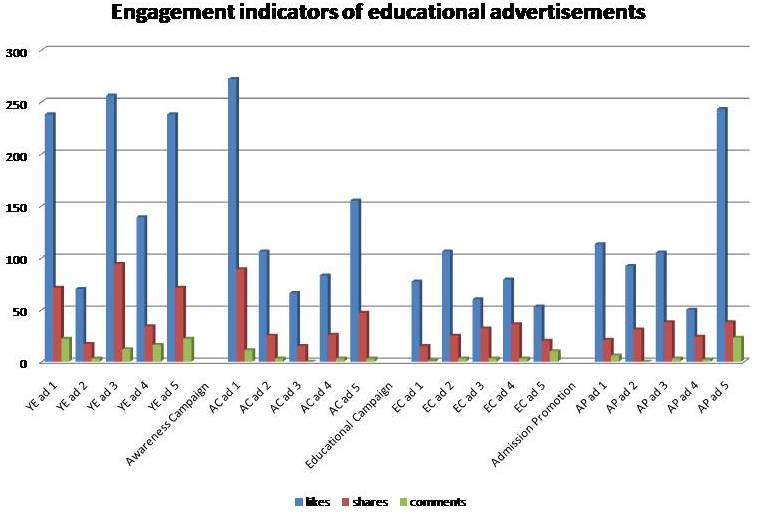
Graph-1.Different types of educational advertisements with engagement indicators
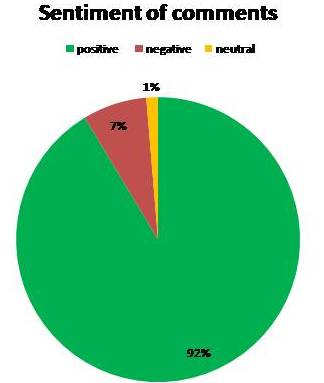
Graph-2 identifieseducational advertisement’s Sentiment of comments as positive, negative, and neutral.The content of educational advertisements, Majority of users taken positively.Small proportion of Negative is noteworthy.As well as neutral sentiment is minimal.
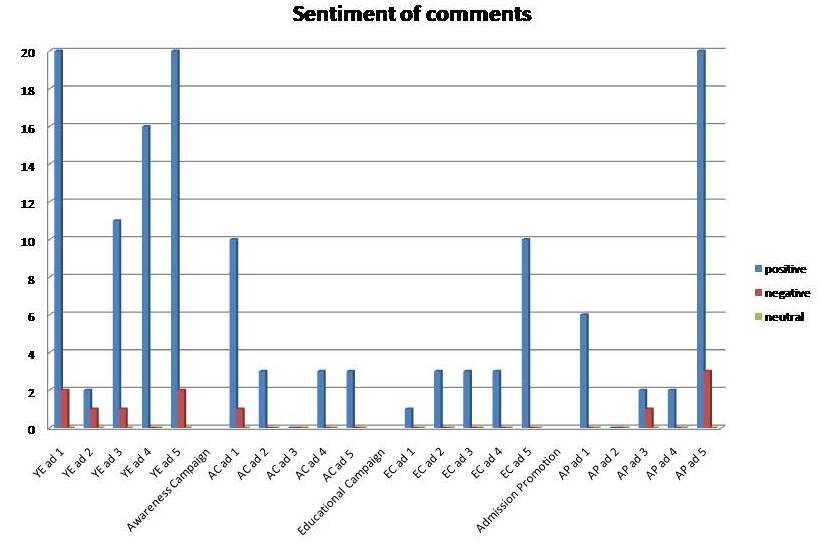
Graph-2. Educational advertisement’s sentiment of comments
It is possible to conclude such results with those of Milić et al. (2024), who also emphasised that the performance of AI-generated visual content can be much better compared to human-created graphics, as the design is accurate due to the automated design, and optimisation processes are carried out in real-time. Similarly, Ratta, Muneer, and ul Hassan (2024) have found that enhanced content of advertisements by AI is more likely to induce consumer engagement and purchasing behaviour, which is also consistent with the engagement patterns in the present study.
Objective-2.To analyse effectiveness of AI-generated educational ads on Facebook in terms of audience interactivity/engagement (likes, shares, comments and sentiment of comments).
Result: The engagement analysis shows that likes have 74% of total interactions, followed by shares (22%), and comments (4%).
Likes being the highest engagement form indicates that AI-generated educational advertisements is much effective. The 22% share rate is particularly noteworthy. Shares represent a deeper level of engagement because they show that viewers found the content valuable enough to pass on to their networks. Share percentage above 20% suggests that the content had significant appeal and perceived usefulness. The 4% comments indicate that a smaller number of users engaged in more detailed interaction. While comments are less, they provide qualitative insights into audience perception, opinions, and concerns.
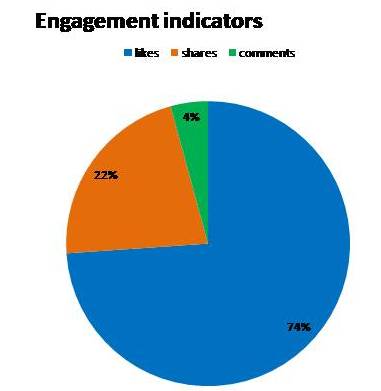
Pie chart. 1
The sentiment analysis of the comments shows that most audience responses were positive at 92%. This strong positive sentiment indicates that audience largely liked the content and show the effectiveness. Comments were negative at 7%, but it still notable because it linked to issues such as disagreement and concerns about the content. while very few were neutral at 1%.
Pie chart. 2
Overall, the dominance of positive sentiment indicate that strong audience acceptance and suggest that content strategy was effective in appealing emotionally to viewers.
Implications of the Study
The study’s findings show that audiences respond more positively to clear, useful, and easy-to-understand digital content. This suggests that creators of educational or AI-generated advertisements should focus on simple messages and strong value to improve user acceptance. The high level of positive engagement indicates that well-designed digital ads can build trust and influence learning behavior. The presence of some negative feedback highlights the need for continuous improvement and careful monitoring of audience responses. Overall, the study shows that audience attitudes, usefulness of information, and ease of understanding directly shape engagement, supporting the effectiveness of digital and AI-driven communication.
Conclusion
The researchers find that the educational advertisements on Facebook created by AI the most effective results in terms of the capacity to reach out to the users, engagement and interaction. However, the findings also reveal that even though the users positively react to the AI-generated contents in the initial stage, the problem of trust and emotional credibility is there. The output suggests that the high effectiveness of AI-generated advertisements in attracting attention, the lowered trustworthiness ratings can indicate that users still resort to the human-designed content to make more serious and commitment-oriented decisions, such as enrolling in a course or a contact with an academic institution. This distinction shows that AI is effective at the very highest point of the marketing funnel, where it generates awareness and initial interest, but human-crafted communication may still be required in the subsequent stages where emotional confidence and trustworthiness are concerned.
Future research dimensions
Future research can expand this study by analyzing larger datasets across multiple platforms to compare sentiment and engagement trends. Longitudinal studies may examine how audience perceptions change over time, especially with increasing use of AI-generated content. Future work could also include qualitative analysis of comment themes to understand deeper motivations behind positive or negative reactions. Comparative studies between human-created and AI-generated posts may reveal differences in credibility, trust, and engagement.
Recommendations
Based on the high positive sentiment and strong engagement, content creators should continue producing relevant, clear, and visually simple messages to enhance user understanding and acceptance. Encouraging shareable elements such as emotional storytelling or informative insights can further improve reach. The 10% negative sentiment highlights the need for continuous monitoring and addressing audience concerns to refine content quality. Increasing interactive elements—such as questions or call-to-action prompts—may boost the low comment rate. Finally, using AI tools for sentiment tracking, personalization, and performance optimization can help tailor future content while testing across platforms to identify the most effective engagement patterns.
Acknowledgement
I would like to express my sincere gratitude to my supervisor Dr. Harinath kumarfor their continuous guidance and valuable feedback for this research. I am also thankful to my colleagues whose cooperation made this study possible. Finally, I extend my appreciation to my family for support during the completion of this research paper.
References
- Albakry, N. S., Hashim, M. E. A., Harun, M. F., & Puandi, M. F. (2025). The Role of Artificial Intelligence in Creative Design for Advertising and Digital Content in Educational Contexts. Semarak International Journal of Creative Art and Design, 4(1), 12-23.
- Ali, I. H. (2025). Evaluating the Promotional Effectiveness of AI-Generated vs. Traditional Images: A Comparative Study of Visual Styles. Journal, Vol, 15(3), 49-61.
- Arshad, S. (2023). Performance of AI Generated Content in Content Marketing. Talling University of Technology School of Business and Governance.
- Baek, T. H., Kim, J., & Kim, J. H. (2024). Effect of disclosing AI-generated content on prosocial advertising evaluation. International Journal of Advertising, 1-22.
- Burrow, E., & Gutentag, J. (2025). AI-generated Versus Human-generated: Creative Content in Advertising. Pepperdine Journal of Communication Research, 13(1), 8.
- Campbell, C., Plangger, K., Sands, S., & Kietzmann, J. (2022). Preparing for an era of deepfakes and AI-generated ads: A framework for understanding responses to manipulated advertising. Journal of Advertising, 51(1), 22-38.
- De Cicco, R., Francioni, B., Curina, I., & Cioppi, M. (2025). AI, human or a blend? How the educational content creator influences consumer engagement and brand-related outcomes. Journal of Services Marketing, 39(10), 52-70.
- Huh, J., Nelson, M. R., & Russell, C. A. (2023). ChatGPT, AI advertising, and advertising research and education. Journal of Advertising, 52(4), 477-482.
- Mamedov, T., & Solunina, E. (2024). The Perception of Generation Z towards AI-Generated Visual Advertising in Finland.
- Matsiola, M., Lappas, G., & Yannacopoulou, A. (2024). Generative AI in Education: Assessing Usability, Ethical Implications, and Communication Effectiveness. Societies, 14(12), 267.
- Milić, B., Spajić, J., Bošković, D., Mitrović, K., & Lalić, D. (2024). AI vs. human designers: evaluating the effectiveness of AI-generated visual content in digital marketing. In Proceedings of the 12th International Symposium GRID 2024.
- Ratta, A. A., Muneer, S., & ul Hassan, H. (2024). The Impact of AI Generated Advertising Content on Consumer Buying Behavior and Consumer Engagement. Bulletin of Business and Economics (BBE), 13(2), 1152-1157.
- Davis, F. D. (1989). Perceived usefulness, perceived ease of use, and user acceptance of information technology. MIS Quarterly, 13(3), 319–340.
- Venkatesh, V., & Davis, F. D. (2000). A theoretical extension of the technology acceptance model: Four longitudinal field studies. Management Science, 46(2), 186–204.
- Venkatesh, V., Morris, M. G., Davis, G. B., & Davis, F. D. (2003). User acceptance of information technology: Toward a unified view. MIS Quarterly, 27(3), 425–478.
- Kaplan, A. M., & Haenlein, M. (2010). Users of the world, unite! The challenges and opportunities of Social Media. Business Horizons, 53(1), 59–68.
- Pang, B., & Lee, L. (2008). Opinion mining and sentiment analysis. Foundations and Trends in Information Retrieval, 2(1–2), 1–135.
- Mangold, W. G., & Faulds, D. J. (2009). Social media: The new hybrid element of the promotion mix. Business Horizons, 52(4), 357–365.
- Sharma, G., & Lal, D. R. (2024). User Engagement and Perception on social media: An Analysis of AI-Generated vs Human-Generated Images in Digital Advertising Campaigns. Available at SSRN 4998135.
- Tabuchi, H., Nakajima, I., Day, M., Yoneda, T., Tanabe, M., Strang, N. … & Tsuji, H. (2024). Comparative educational effectiveness of AI generated images and traditional lectures for diagnosing chalazion and sebaceous carcinoma. Scientific Reports, 14(1), 29200.
- Thi Nguyen, L. A., Nguyen, T. P., Vu, M. D., Nguyen, T. H., Tran, T. V. T., & Tran, T. H. (2024). The Influence of AI-generated vs. Human-Generated Advertising on Purchase Intention: A Study of Vietnamese Consumers.
- Tien-Phuong and Vu, Minh Duc and Nguyen, Tuan-Hung and Tran, Thao-Vy Thi and Tran, Thi-Hao, The Influence of Ai-Generated vs. Human-Generated Advertising on Purchase Intention: A Study of Vietnamese Consumer.