

A Study of Advertisements Aimed at Raising Awareness Among
Women About Government Schemes in Hindi Daily Newspaper Dainik Jagran
– Swati Gupta[1]
– Dr. Jitendra Dabral[2]
Abstract:
This study investigates the role and effectiveness of advertisements published in the Hindi daily newspaper Dainik Jagran in fostering awareness among women regarding various government schemes. In the Indian context, where gender disparities continue to shape access to information and resources, mass media serves as a critical instrument for bridging communication gaps. The Government of India has introduced multiple schemes aimed at women’s welfare, empowerment, health, and financial inclusion. However, the success of these initiatives is contingent upon the effective dissemination of information, particularly among women residing in semi-urban and rural areas.
Employing a qualitative content analysis approach, the research examines the nature, frequency, and placement of government scheme advertisements in Dainik Jagran. It further assesses the extent to which these advertisements respond to women’s specific needs and concerns, as well as their effectiveness in communicating eligibility criteria, benefits, and application procedures. The findings indicate that, although government scheme advertisements are present in significant numbers, their effectiveness in reaching and engaging the intended female audience varies considerably. The study underscores the necessity of developing more tailored communication strategies that emphasize clarity, inclusivity, and regional relevance. The conclusions provide recommendations for strengthening the outreach and impact of public welfare communication through print media.
Keywords: Social Advertisement, Government Policies, Women Awareness, Print Media, Dainik Jagran
Social Advertisement and its role in raising awareness
Advertising has a significant impact on raising awareness and shaping public opinion. Print media has played a vital part in educating and disseminating knowledge in India. Newspapers’ renown and extensive reach make them one of the most important print media. One of the top Hindi daily newspapers, Dainik Jagran, has utilized ads to raise awareness of a number of topics, including women’s empowerment.
Social advertising, often known as PSAs (Public Service Announcements), are not meant to convince people to purchase goods or services, but rather to educate and alter their perspective on specific social concerns. In fact, the main objectives of social advertisements are education and persuasion, with the ultimate goal of altering social perception and, in turn, people’s behaviour for the benefit of both the individual and society at large. (Kotler and Zaltman, 1971). These advertisements promote health, safety, the environment, and social equality.
The oldest instances of social advertising may be traced back to the 1900s, when governments and non-profit groups used print media to promote public health initiatives such as sanitation during the Spanish flu pandemic. A social advertising may provide a simplified message with an artistic and realistic picture of a complex societal issue, appealing to the audience’s emotional and personal emotions. (Rice & Atkin, 2012).
Current social commercials, for example, strive to use studies in social psychology and communication theories to improve the effectiveness of the ads developed. For exampleThey may utilize threat appeals, norm activation, or rewards to persuade the target audience to perform the desired behavior. The goal of such commercials in healthcare that facilitate change is not just to persuade and educate patients, families, and the public, but also to engage audiences and drive a more engaged and educated citizenry (Andreasen, 1995).
Social advertising has a significant impact on social beliefs and habits, particularly among women. Awareness initiatives such as World Cancer Day may start important talks and develop deeper debates on serious issues like cancer all across the world by utilizing different mediums such as press and media. Furthermore, research into the impact of beauty marketing in women’s magazines on mood and body dissatisfaction demonstrates the powerful influence these commercials can have on women’s mental health and self-perception.
Need for Targeted Awareness Among Women Regarding Government Welfare Schemes
Women, especially in rural and semi-urban regions, frequently lack awareness of the welfare programs intended to enhance their education, health, safety, and economic empowerment. Notwithstanding the plethora of government initiatives, including Beti Bachao Beti Padhao, Ujjwala Yojana, and Sukanya Samriddhi Yojana, a substantial knowledge gap endures due to impediments like as restricted literacy, socio-cultural limitations, and inadequate access to relevant information. Targeted awareness is crucial to close this gap and guarantee that women not only obtain information but also comprehend the advantages and processes for accessing these schemes. Tailored communication tactics employing regional languages, related images, and accessible media channels—such as local newspapers and community radio—can improve outreach. Facilitating women’s informed engagement in welfare programs is essential for inclusive development and the efficacy of government initiatives focused on social and economic advancement.
Government policy advertisements in print media are crucial for disseminating information about various welfare schemes and initiatives aimed at social development. The advertisements serve as a conduit between the government and the public, ensuring that citizens, particularly marginalized groups such as women, are aware of their rights, benefits, and available support systemsThe government of Uttar Pradesh has implemented numerous policies and programs to empower and benefit women. Some of the government’s programs for women’s empowerment include Kanya Sumangala Yojana, Rani Lakshmi Bai Mahila Samman Kosh, Mission Shakti, Ujjwala Yojana, and Mukhyamantri Mahila Samarthya Yojana.
Relevance of Studying Advertisements in Dainik Jagran
Dainik Jagran is one of India’s most popular Hindi daily newspapers, with a large circulation in Kanpur. This newspaper’s coverage in Kanpur city includes households, schools, colleges, and companies. With a large readership, advertisements in Dainik Jagran will undoubtedly reach and influence the minds of a vast and diversified segment of Kanpur society.
Dainik Jagran’s advertisement analysis is particularly relevant because to its influence, Kanpur’s diverse population, and critical societal issues. It might provide useful suggestions about the role of print media in raising awareness and effecting social change, particularly in terms of women’s rights and empowerment in urban India.
Theoretical Approach:
Diffusion of Innovations Theory (Everett Rogers, 1962):
The Diffusion of Innovation Theory, proposed by Everett Rogers (1962), explains how new ideas, practices, or technologies spread within a social system over time. It emphasizes that innovation adoption occurs in stages—awareness, interest, evaluation, trial, and adoption—through communication channels among members of a community. The theory categorizes adopters into innovators, early adopters, early majority, late majority, and laggards, based on the speed and willingness with which they accept change. Mass media play a crucial role in creating initial awareness, while interpersonal networks often determine whether individuals embrace or reject an innovation. In the context of advertisements about government schemes in Dainik Jagran, these schemes represent innovations introduced to women readers, with the newspaper acting as a communication channel. The effectiveness of such advertisements can thus be analyzed by examining how far they move women from mere awareness to actual adoption and utilization of government benefits.
Participatory Communication Theory (Bella Mody’s Theory):
Bella Mody’s theory of participatory communication emphasizes that communication for development should not be a one-way, top–down process, but rather a dialogic and inclusive approach that engages communities in understanding and utilizing information relevant to their lives. According to Mody, true empowerment occurs when messages are culturally relevant, accessible, and designed to encourage active participation, particularly among marginalized groups such as women. In the context of the present research, which examines advertisements in the Hindi daily Dainik Jagran aimed at raising awareness about government schemes among women, Mody’s theory provides a valuable framework. It allows us to evaluate whether these advertisements merely disseminate information or genuinely enable women to connect with, understand, and act upon the opportunities provided by government initiatives. Thus, the study not only explores the visibility of such advertisements but also critically analyzes their role in fostering participatory awareness, empowerment, and inclusivity as envisioned by Bella Mody.
Objectives of the research:
- To analyze the frequency and placement of government scheme advertisements targeting women in Dainik Jagran.
- To examine the content, language, and presentation style of these advertisements in terms of their clarity, appeal, and accessibility for women readers.
- To evaluate the extent of awareness generated among women readers about government schemes through these advertisements.
- To assess women’s perception and response towards the effectiveness, relevance, and credibility of such advertisements.
- To identify gaps and suggest improvements in the design and communication strategies of government advertisements for enhancing women’s awareness and participation in these schemes.
Literature Review:
There is a significant corpus of literature on the media’s influence on gender issues. Various examples have examined how print media, in particular, may inform and empower women. This paper provides a review of several similar studies that have been undertaken on the role of newspapers in female empowerment under the theme Media Influence and Women’s Empowerment, with a concentration on print media.
Kotler and Zaltman (1971) first conceptualized social marketing as a deliberate strategy for planned social change, emphasizing the extension of marketing principles beyond commercial domains to advance social causes and behavioral transformation. Their pioneering framework established the foundation for subsequent scholarship on the role of media in fostering social awareness and development.
Building on this, Andreasen (1995) advanced social marketing theory by highlighting its application in health, social development, and environmental contexts. His work underscored the importance of audience-specific communication strategies, thereby demonstrating how tailored media campaigns can effectively facilitate behavioral change and social progress.
In the Indian context, Nautiyal and Dabral (2012) examined representations of women’s issues in newspapers across Uttarakhand. Their findings revealed that although coverage of women’s concerns had increased, such issues were often underrepresented or framed stereotypically, pointing to a persistent gap between the potential and actual role of media in women’s empowerment.
Rice and Atkin (2012) offered an extensive framework for understanding public communication campaigns, emphasizing the integration of theoretical perspectives with practical execution in campaign design, implementation, and evaluation. Their analysis reinforced the necessity of theory-driven approaches for maximizing the impact of media in public life.
Similarly, Rao (2013) provided a comprehensive overview of media and gender, analyzing how media discourse influences societal perceptions of women. Her work emphasized the need for critical engagement with media texts to unpack gendered representation and its implications for empowerment. Gallagher (2014) further extended feminist communication theory by situating media practices within broader power and gender dynamics, arguing that representation and messaging shape women’s agency and participation in society.
Kaur (2015), through a content analysis of Indian print advertisements, investigated the complex relationship between advertising and women’s empowerment. The study revealed dual narratives: while some advertisements promoted progressive portrayals, many reinforced conventional stereotypes, illustrating advertising’s contradictory role in empowerment discourse. Gupta (2016) similarly explored media’s role in shaping women’s self-perceptions and social roles, finding that the influence of media campaigns was contingent upon audience literacy, cultural contexts, and access to media.
In examining media’s transformative potential in social issues, Roy and Das (2017) assessed domestic violence awareness campaigns in Kolkata. Their study demonstrated that sustained campaigns were effective in raising awareness, shifting attitudes, and encouraging public discourse around sensitive issues. Williams, Brown, Davis, and Taylor (2017) extended this perspective to local journalism, showing that regional newspapers foster civic participation and strengthen democratic practices by connecting citizens to community-level issues.
The impact of digital transformation on regional newspapers has also been widely studied. Davis (2018) highlighted both the opportunities and challenges posed by digitalization, particularly in balancing broader reach with revenue generation and public trust. Brown and Garcia (2019) examined how different news platforms affect civic participation, finding that traditional newspapers were more effective in promoting political engagement, while digital platforms were better suited for encouraging social participation. Complementing this, Robinson and Lee (2019) demonstrated that newspapers provided credibility and depth, whereas digital platforms offered immediacy and interactivity, with both being essential for sustaining informed communities.
Parallel to these developments, Dasgupta (2019) established a positive correlation between women’s media exposure and empowerment indicators such as decision-making power, mobility, and access to information. Smith (2019) also highlighted the catalytic role of regional newspapers in local transformation, arguing that they function as amplifiers of community voices rather than mere information providers. Garcia and Nguyen (2020) reinforced this view through a comparative study, finding that regional outlets were more effective than national media in addressing grassroots issues, thereby fostering inclusive communication.
Miller (2020) emphasized the critical role of regional print media in health communication, especially during crises, where localized dissemination complemented national campaigns. Yet, as Thomas (2021) noted, regional newspapers face existential challenges due to declining revenues, readership, and competition from online platforms, despite their enduring social relevance.
Government-led interventions have also been closely linked to media communication. Shukla (2022) and Sharma (2023) both highlighted the significance of mass media in ensuring the effectiveness of women-focused policies. They argued that while policy frameworks hold transformative potential, their success depends heavily on communication and outreach strategies that connect beneficiaries with available schemes.
Research Methodology:
The study sample includes all advertisements from the designated era and the specific category of women’s awareness. This includes government policies advertisements related to health, education, human rights, and social issues affecting women. To validate the perceived findings, a quantitative method is used to determine the quantity of Women Awareness adverts, their size, and their placement in the newspaper. To achieve the objective of the study, a specific time period of the six months is selected in which the data is collected from every alternate day of these months and a sample of advertisements that fall under the specified criteria are collected.
Data Analysis
Comparative Analysis
Comparison of advertisements: To provide more context and depth to the analysis, the study includes a full comparative analysis of Women Awareness commercials from all advertisements in the Hindi daily ‘Dainik Jagran’. This helps to understand the various aspects that contribute to the volume and size of women’s awareness adverts in a specific newspaper called the Dainik Jagran.
Tools and Techniques used for data analysis:
Physical rulers and measuring scales are used in manual measuring advertisement space in print newspaper Dainik Jagran.
Result and Discussion:
January:
Table-1: Ads. Comparison for the month of January
| Date
|
Total number of Ads. | Total Advertisement Space
(in cm2) |
Total number of women awareness Ads. | Women Awareness Ads. Space
(in cm2) |
Percentage (%) of Women Awareness Ads.to the total Ads. |
| 02/01/2024 | 22 | 5328 | 2 | 1400 | 9.09 |
| 04/01/2024 | 26 | 4340 | 2 | 916 | 7.69 |
| 06/01/2024 | 42 | 9058 | 2 | 800 | 4.76 |
| 08/01/2024 | 27 | 5300 | 1 | 400 | 3.70 |
| 10/01/2024 | 33 | 10997 | 2 | 2064 | 6.06 |
| 12/01/2024 | 43 | 10659 | 2 | 2464 | 4.65 |
| 14/01/2024 | 60 | 14278 | 2 | 8803 | 3.33 |
| 16/01/2024 | 31 | 8363 | 1 | 1664 | 3.22 |
| 18/01/2024 | 32 | 5044 | 2 | 800 | 6.25 |
| 20/01/2024 | 35 | 16401 | 2 | 916 | 5.71 |
| 22/01/2024 | 38 | 13088 | 2 | 916 | 5.26 |
| 24/01/2024 | 27 | 7904 | 3 | 3064 | 11.11 |
| 26/01/2024 | 60 | 34861 | 5 | 3498 | 8.33 |
| 28/01/2024 | 62 | 14375 | 3 | 600 | 4.83 |
| 30/01/2024 | 20 | 4271 | 1 | 400 | 5 |
| Grand Total | 558 | 164267 | 28 | 28705 | 5.01 |
In the month of January, total number of days selected were fifteen as shown in Table 1. In these fifteen days total number of advertisements published were 558, including 28 women awareness ads., total space covered by advertisements was 1,64,267 cm², with women awareness ads taking up 28,705 cm², or 17.47% of the total ad space.
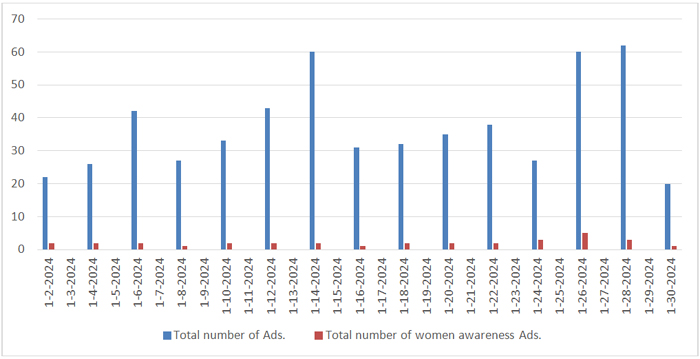
Fig.-1: Comparison of women awareness Ads. with the total number of Ads.
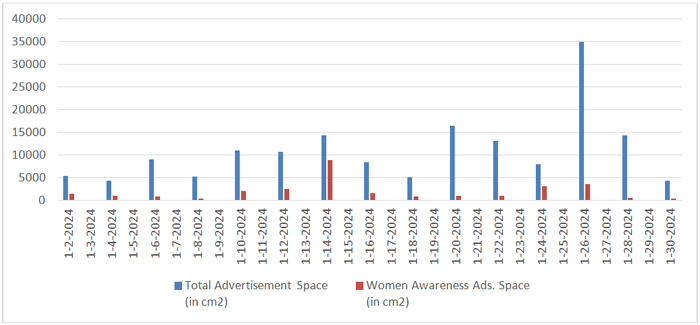
Fig.-2: Comparison of Women Awareness Ads. Space with the total Advertisement Space
February:
Table-2: Ads. Comparison for the month of February
| Date
|
Total number of Ads. | Total Advertisement Space
(in cm2) |
Total number of women awareness Ads. | Women Awareness Ads. Space
(in cm2) |
Percentage (%) of Women Awareness Ads.to the total Ads. |
| 02/02/2024 | 22 | 2930 | 2 | 400 | 9.09 |
| 04/02/2024 | 65 | 24777 | 6 | 5068 | 9.23 |
| 06/02/2024 | 25 | 3620 | 2 | 800 | 8 |
| 08/02/2024 | 25 | 3800 | 3 | 926 | 12 |
| 10/02/2024 | 32 | 5032 | 2 | 1126 | 6.25 |
| 12/02/2024 | 60 | 16900 | 5 | 3028 | 8.33 |
| 14/02/2024 | 39 | 6412 | 4 | 1860 | 10.25 |
| 16/02/2024 | 28 | 5044 | 3 | 916 | 10.71 |
| 18/02/2024 | 32 | 4832 | 2 | 800 | 6.25 |
| 20/02/2024 | 33 | 16401 | 2 | 724 | 6.06 |
| 22/02/2024 | 40 | 13186 | 4 | 1220 | 10 |
| 24/02/2024 | 22 | 3248 | 3 | 3064 | 13.63 |
| 26/02/2024 | 56 | 13928 | 5 | 4823 | 8.92 |
| 28/02/2024 | 23 | 3124 | 3 | 622 | 13.04 |
| Grand Total | 502 | 123234 | 46 | 25377 | 9.16 |
In the month of February, total number of days selected were fourteen as shown in Table 2. In these fourteen days total number of advertisements published were 502, including 46 women awareness ads., total space covered by advertisements was 1,23,234 cm², with women awareness ads taking up 25,377 cm², or 20.59% of the total ad space.
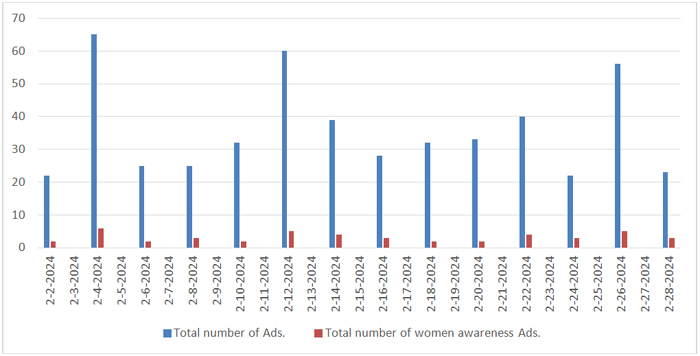
Fig.-3: Comparison of women awareness Ads. with the total number of Ads.
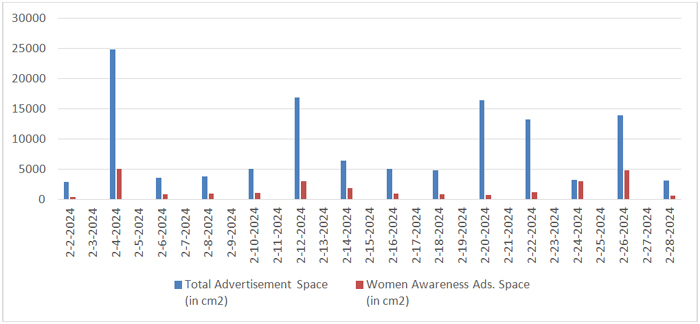
Fig.-4: Comparison of Women Awareness Ads. Space with the total Advertisement Space
March:
Table-3: Ads. Comparison for the month of March
| Date
|
Total number of Ads. | Total Advertisement Space
(in cm2) |
Total number of women awareness Ads. | Women Awareness Ads. Space
(in cm2) |
Percentage (%) of Women Awareness Ads.to the total Ads. |
| 02/03/2024 | 32 | 3941 | 3 | 916 | 9.37 |
| 04/03/2024 | 39 | 4386 | 1 | 800 | 2.56 |
| 06/03/2024 | 42 | 6428 | 2 | 422 | 4.76 |
| 08/03/2024 | 60 | 20215 | 11 | 6100 | 18.33 |
| 10/03/2024 | 31 | 3624 | 3 | 800 | 9.67 |
| 12/03/2024 | 36 | 13761 | 6 | 4888 | 16.66 |
| 14/03/2024 | 33 | 3321 | 2 | 243 | 6.06 |
| 16/03/2024 | 45 | 19467 | 3 | 3628 | 6.66 |
| 18/03/2024 | 42 | 1433 | 4 | 3925 | 9.52 |
| 20/03/2024 | 34 | 9591 | 2 | 800 | 5.88 |
| 22/03/2024 | 33 | 4257 | 2 | 916 | 6.06 |
| 24/03/2024 | 36 | 10181 | 2 | 1216 | 5.55 |
| 26/03/2024 | 30 | 3921 | 1 | 213 | 3.33 |
| 28/03/2024 | 32 | 5715 | 1 | 225 | 3.12 |
| 30/03/2024 | 29 | 4259 | 2 | 916 | 6.89 |
| Grand Total | 554 | 114500 | 45 | 26008 | 8.12 |
In the month of March, total number of days selected were fifteen as shown in Table 3. In these fifteen days total number of advertisements published were 554, including 45 women awareness ads., total space covered by advertisements was 1,14,500 cm², with women awareness ads taking up 26,008 cm², or 22.71% of the total ad space.
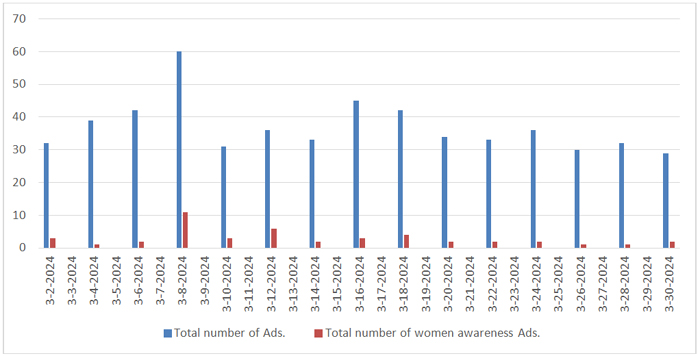
Fig.-5: Comparison of women awareness Ads. with the total number of Ads.
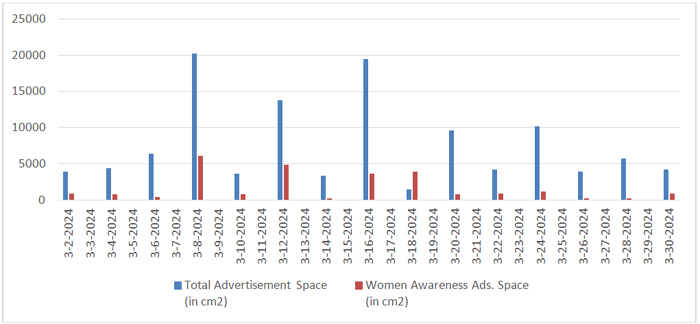
Fig.-6: Comparison of Women Awareness Ads. Space with the total Advertisement Space
April:
Table-4: Ads. Comparison for the month of April
| Date | Total number of Adv. | Total Advertisement Space
(in cm2) |
Total number of women awareness Adv. | Women Awareness Adv. Space
(in cm2) |
Percentage (%) of Women Awareness Ads.to the total Ads. |
| 02/04/2024 | 28 | 5236 | 2 | 800 | 7.14 |
| 04/04/2024 | 33 | 10205 | 3 | 720 | 9.09 |
| 06/04/2024 | 36 | 9581 | 3 | 924 | 8.33 |
| 08/04/2024 | 35 | 9483 | 3 | 1840 | 8.57 |
| 10/04/2024 | 25 | 4231 | 2 | 216 | 8 |
| 12/04/2024 | 29 | 5329 | 2 | 480 | 6.89 |
| 14/04/2024 | 31 | 4462 | 1 | 80 | 3.22 |
| 16/04/2024 | 41 | 9594 | 1 | 80 | 2.43 |
| 18/04/2024 | 45 | 10320 | 4 | 1856 | 8.88 |
| 20/04/2024 | 39 | 7664 | 3 | 880 | 7.69 |
| 22/04/2024 | 42 | 5823 | 4 | 1856 | 9.52 |
| 24/04/2024 | 38 | 6122 | 1 | 80 | 2.63 |
| 26/04/2024 | 39 | 5128 | 3 | 824 | 7.69 |
| 28/04/2024 | 36 | 9542 | 4 | 1920 | 11.11 |
| 30/04/2024 | 35 | 8940 | 3 | 428 | 8.57 |
| Grand Total | 532 | 111660 | 39 | 12984 | 7.33 |
In the month of April, total number of days selected were fifteen as shown in Table 4. In these fifteen days total number of advertisements published were 532, including 39 women awareness ads., total space covered by advertisements was 1,11,660 cm², with women awareness ads taking up 12,984 cm², or 11.62% of the total ad space.
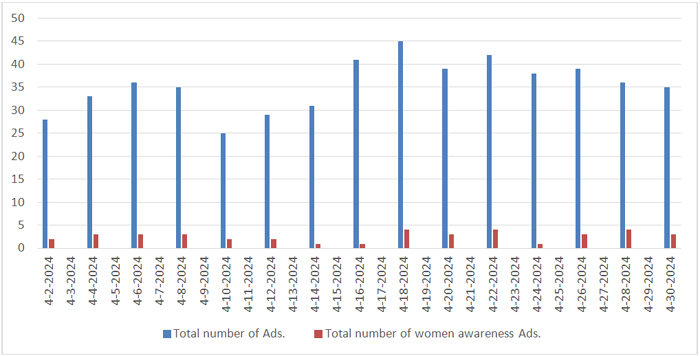
Fig.-7: Comparison of women awareness Ads. with the total number of Ads.
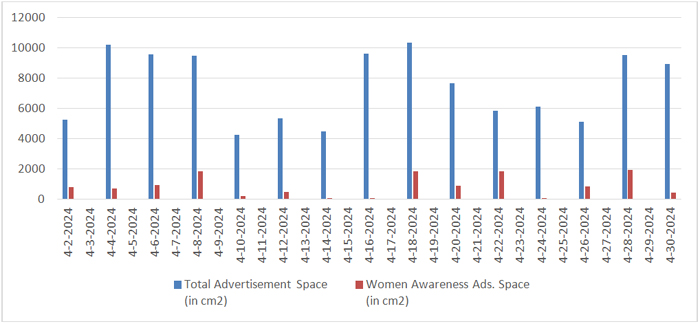
Fig.-8: Comparison of Women Awareness Ads. Space with the total Advertisement Space
May:
Table-5: Ads. Comparison for the month of May
| Date | Total number of Adv. | Total Advertisement Space
(in cm) |
Total number of women awareness Adv. | Women Awareness Adv. Space
(in cm) |
Percentage (%) of Women Awareness Ads.to the total Ads. |
| 02/05/2024 | 41 | 10260 | 2 | 916 | 4.87 |
| 04/05/2024 | 43 | 13680 | 3 | 1712 | 6.97 |
| 06/05/2024 | 39 | 9482 | 2 | 800 | 5.12 |
| 08/05/2024 | 43 | 7483 | 1 | 80 | 2.32 |
| 10/05/2024 | 42 | 12241 | 4 | 684 | 9.52 |
| 12/05/2024 | 45 | 11698 | 1 | 400 | 2.22 |
| 14/05/2024 | 38 | 4562 | 2 | 916 | 5.26 |
| 16/05/2024 | 43 | 8307 | 1 | 80 | 2.32 |
| 18/05/2024 | 40 | 14321 | 2 | 800 | 5 |
| 20/05/2024 | 36 | 6348 | 3 | 1338 | 8.33 |
| 22/05/2024 | 35 | 4357 | 5 | 782 | 14.28 |
| 24/05/2024 | 38 | 7467 | 1 | 80 | 2.63 |
| 26/05/2024 | 42 | 8325 | 4 | 1156 | 9.52 |
| 28/05/2024 | 37 | 8788 | 1 | 800 | 2.70 |
| 30/05/2024 | 39 | 5826 | 3 | 1232 | 7.69 |
| Grand Total | 601 | 133145 | 35 | 11776 | 5.82 |
In the month of May, total number of days selected were fifteen as shown in Table 5. In these fifteen days total number of advertisements published were 601, including 35 women awareness ads., total space covered by advertisements was 1,33,145 cm², with women awareness ads taking up 11,776 cm², or 8.8% of the total ad space.
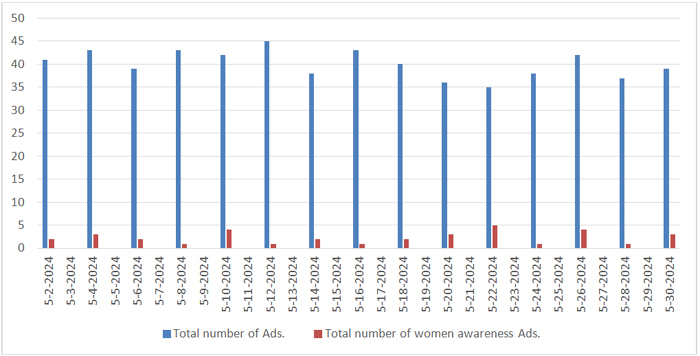
Fig.-9: Comparison of women awareness Ads. with the total number of Ads.
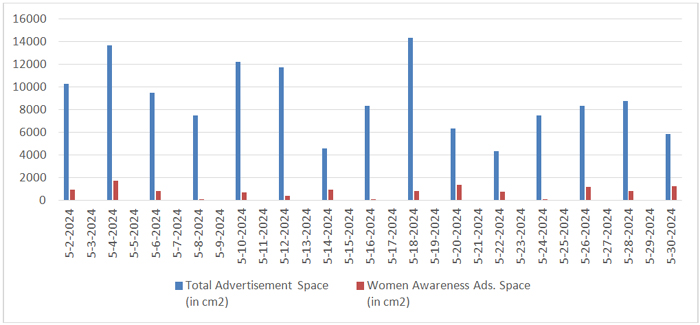
Fig.-10: Comparison of Women Awareness Ads. Space with the total Advertisement Space
June:
Table-6: Ads. Comparison for the month of June
| Date | Total number of Adv. | Total Advertisement Space
(in cm) |
Total number of women awareness Adv. | Women Awareness Adv. Space
(in cm) |
Percentage (%) of Women Awareness Ads.to the total Ads. |
| 02/06/2024 | 31 | 9261 | 3 | 1231 | 9.67 |
| 04/06/2024 | 33 | 8245 | 2 | 426 | 6.06 |
| 06/06/2024 | 42 | 10482 | 4 | 934 | 9.52 |
| 08/06/2024 | 38 | 6482 | 2 | 800 | 5.26 |
| 10/06/2024 | 35 | 10241 | 1 | 80 | 2.85 |
| 12/06/2024 | 40 | 13698 | 3 | 916 | 7.5 |
| 14/06/2024 | 38 | 2562 | 3 | 824 | 7.89 |
| 16/06/2024 | 22 | 7420 | 2 | 800 | 9.09 |
| 18/06/2024 | 25 | 3452 | 2 | 132 | 8 |
| 20/06/2024 | 33 | 5621 | 1 | 80 | 3.03 |
| 22/06/2024 | 36 | 9523 | 4 | 1235 | 11.11 |
| 24/06/2024 | 30 | 5467 | 2 | 425 | 6.66 |
| 26/06/2024 | 42 | 13325 | 2 | 425 | 4.76 |
| 28/06/2024 | 38 | 6425 | 3 | 916 | 7.89 |
| 30/06/2024 | 32 | 4826 | 1 | 80 | 3.12 |
| Grand Total | 515 | 117030 | 35 | 9304 | 6.79 |
In the month of June, total number of days selected were fifteen as shown in Table 6. In these fifteen days total number of advertisements published were 515, including 35 women awareness ads., total space covered by advertisements was 1,17,030 cm², with women awareness ads taking up 9,304 cm², or 7.9% of the total ad space.
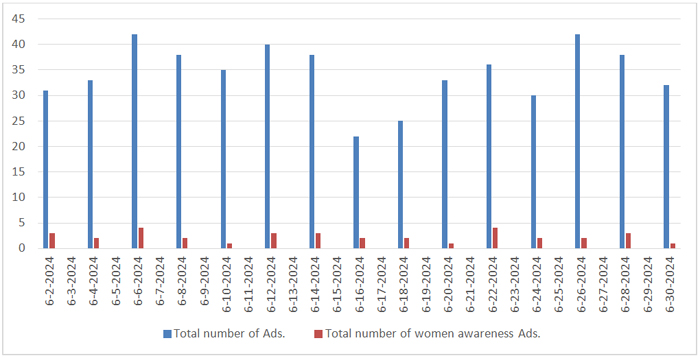
Fig.-11: Comparison of women awareness Ads. with the total number of Ads.
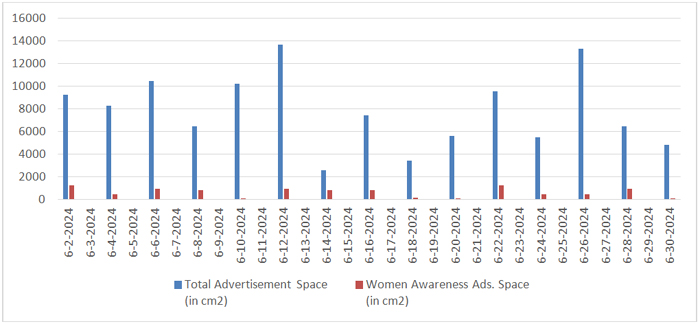
Fig.-12: Comparison of Women Awareness Ads. Space with the total Advertisement Space
Findings:
Advertisements serve as vital for informing the public about new policies and initiatives that benefit their health, as well as fast changing trends. The study compares the total number of advertisements and the amount of space they take up with advertisements relating to women’s awareness.
The data shows that the total number of commercials and the fraction of women awareness ads fluctuated over the six-month period. While the overall number of commercials varied from month to month, the space devoted to women’s awareness ads declined after peaking in March (22.71%). The maximum number of women awareness ads were registered in February (46), while the lowest ad space allocation occurred in June (7.9%).
These findings show that while efforts were made to raise women’s awareness through advertisements, the amount of prominence given to such ads fluctuated, indicating potential areas for enhanced visibility and sustained focus on women-centric message in future advertising campaigns.
Recommendations:
- Government scheme advertisements for women should not fluctuate heavily month-to-month. A consistent presence across all editions and months will help sustain visibility and awareness.
- Since ad space declined after March, government bodies should maintain continuous emphasis on women’s awareness, ensuring that schemes are not overshadowed by other campaigns.
- Beyond publishing, mechanisms such as feedback surveys, helplines, or QR codes should be integrated into advertisements to track actual awareness and engagement among women readers.
- Government agencies must focus on building trust by showcasing success stories of women beneficiaries and highlighting transparency in scheme implementation.
- While overall advertising volumes may vary, a fixed minimum percentage of space should be reserved for women-focused schemes in every edition.
- Use bilingual/multilingual formats where necessary, interactive campaigns, and integration with social media platforms to complement newspaper advertisements and broaden outreach.
Limitations:
This research is limited to the region of Kanpur being focused on Kanpur city edition for sampling.
References:
- Andreasen, A. R. (1995). Marketing social change: Changing behavior to promote health, social development, and the environment. Jossey-Bass.
- Brown, A., & Garcia, M. (2019). Local news and civic participation: Examining differential effects of news platforms on political and non-political engagement. Journal of Communication, 69(3), 297–318.
- Dasgupta, S. (2019). Impact of exposure to mass media on female empowerment: Evidence from India. International Journal of Development Issues, 18(2). https://doi.org/10.1108/IJDI-10-2018-0156
- Davis, R. (2018). The future of local newspapers: A case study of digital transformation. Journal of Media Business Studies, 15(2), 89–104.
- Advertising in Dainik-Jagran Hindi. (n.d.). Ginger Media Group. Retrieved June 5, 2024, from https://www.gingermediagroup.com/advertising-in-dainik-jagran-hindi/
- Influence of print media advertisements on women. (n.d.). ScholarWorks. Retrieved June 5, 2024, from https://scholarworks.umt.edu
- Gallagher, M. (2014). Feminist communication theory. In L. L. Kaid & C. Holtz-Bacha (Eds.), Encyclopedia of political communication (pp. 257–262). SAGE Publications.
- Garcia, L., & Nguyen, T. (2020). The role of local media in community development: A comparative analysis of regional and national news coverage. Community Development Journal, 55(4), 532–550.
- Gupta, A. (2016). The role of media in promoting women’s empowerment in India. Journal of Media and Communication Studies, 8(4), 34–42. https://doi.org/10.5897/JMCS2016.0450
- Kaur, R. (2015). Advertising and the empowerment of Indian women: A content analysis of selected print ads. International Journal of Social Sciences and Humanities Research, 3(2), 100–112.
- Kotler, P., & Zaltman, G. (1971). Social marketing: An approach to planned social change. Journal of Marketing, 35(3), 3–12.
- Miller, S. (2020). The impact of regional newspapers on public health awareness: A comparative analysis. Health Communication, 35(6), 731–749.
- Nautiyal, V., & Dabral, J. (2012). Women issues in newspapers of Uttarakhand. Global Media Journal – Indian Edition, 3(1). University of Calcutta. Retrieved from https://www.caluniv.ac.in/global-mdia-journal/Commentaries/C1%20N%20DABRAL.pdf
- Rao, S. (2013). Media and gender: An overview. Journal of Media Studies, 28(1), 1–12.
- Rice, R. E., & Atkin, C. K. (2012). Public communication campaigns. SAGE Publications.
- Robinson, J., & Lee, S. (2019). Local news in the digital age: Comparing the impact of regional newspapers and digital platforms on community cohesion. New Media & Society, 21(11–12), 2585–2605.
- Roy, S., & Das, D. (2017). Impact of media campaigns on domestic violence awareness in Kolkata. International Journal of Communication Research, 7(3), 219–228.
- Sharma, K. (2023). Empowering women through policy programs: An analysis of government schemes. International Journal of Law Management & Humanities, 6(5). https://doij.org/10.10000/IJLMH.115966
- Shukla, N. (2022). Role of government-led schemes in empowering women in India. Journal of Women Empowerment and Studies, 2(06). https://doi.org/10.55529/jwes.26.26.33
- Smith, P. (2019). The role of regional newspapers in promoting social change: A qualitative analysis. Journal of Social Issues, 75(2), 345–362.
- Thomas, E. (2021). Challenges facing regional newspapers in the digital era: A case study of local journalism in transition. Journalism Practice, 15(3), 369–386.
- Williams, M., Brown, L., Davis, H., & Taylor, J. (2017). Community engagement and local media: Exploring the impact of regional newspapers on civic participation. Journal of Civic Engagement, 10(1), 45–63.
[1] Research Scholar, Institute of Journalism and Mass Communication, Chhatrapati Shahu Ji Maharaj University, Kanpur, Uttar Pradesh, Swtgpt697@gmail.com, 8090685667
[2] Assistant Professor, Institute of Journalism and Mass Communication, Chhatrapati Shahu Ji Maharaj University, Kanpur, Uttar Pradesh