

A study on Readers habit and attitude towards advertisements displayed on Hindi news websites
Lokendra Singh Rajput[1]
Dr. Gajendra Singh Awasya[2]
Abstract:
In this era of internet and mobile revolution, Hindi news websites have become a fast, wide and practical medium for dissemination of news. The popularity of news websites and their applications is increasing rapidly among readers to get news. Due to the increasing number of readers and participation on Hindi news websites, advertising companies have also understood their importance. Hindi news websites are full of advertisements. Readers have their own views about the advertisements appearing on the website. While reading news, readers also get the option to remove the advertisements displayed on the screen, due to this the habits and attitude of readers towards advertisements are developing in different ways. Readers see the advertisements displayed online as a convenience because by clicking on the displayed advertisement, the reader can directly reach the website of the company to purchase it or avail its services. Based on the behaviour of the readers on the Internet, they start seeing the advertisement of the desired product or service. One view of the readers is also that while reading news, the advertisements appearing on the Hindi news website become a hindrance in reading the news. In this research, we have tried to find the habit of the readers regarding the advertisements displayed on the Hindi news website. Do they click on the advertisements. We also try to find the readers see the advertisements as a hindrance in their main task of reading the news. Using a quantitative descriptive survey method, data was collected through structured questionnaires from 404 respondents in urban and rural areas of Bhopal from media organizations, data was further analysed via statically technique using cross-tabulation and chi-square tests. The research concludes that the reader sees the advertisements displayed on news websites as an interruption in reading the news.
Keywords: Advertisement, Hindi news website, Media habits, Digital media.
Introduction
In this era of information technology, mobile and internet revolution, digital media has become the main medium for information and news. To reach the news to the readers, media institutions are using news websites along with printed versions of newspapers. Hindi news websites have also succeeded in making their place among the readers due to their features. When news has reached the digital era through traditional media, then along with them, advertisements have also reached the digital platform. There is a deep connection between the dissemination of advertisements to the readers through news media. News media is the main medium of mass communication. Through these, companies try to reach maximum consumers by displaying advertisements of their products or services. Therefore, advertising companies have kept pace with the development and changing form of media. Initially, when newspapers came, different categories of advertisements were published in them along with news. When electronic media came, advertisements adapted themselves in audio-visual form. Now that modern media is available in the form of digital media, here also advertising has changed its form with digital media. In the preface of Dr. Ashish Dwivedi’s book ‘Advertising Magic’, senior journalist Shivkumar Vivek writes, “In the age of the Internet, it has come in a new avatar in the form of webvertising” (Vivek, 2024). The world of advertising invites us at every step. A person is surrounded by advertisements from all sides. In the present times, advertising has become an important part of the market world. According to a statistic, the average person sees 280 to 310 advertisements per day (Samar, 2023). The revolution of mobile and internet has given more speed to the spread of advertising. “If you open YouTube on mobile, there too advertisements are eager to welcome you, which you will have to see even if you don’t want to. There is a plethora of advertisements on social media. Whether it is Facebook or X-former Twitter, Instagram or LinkedIn, there is a plethora of advertisements everywhere. Whether you open any website or newspaper portal, the first encounter is going to be with advertisements” (Dwivedi, 2024).
In digital media, news websites are more reliable than other platforms and a large number of visitors (readers) also visit them daily. Due to the popularity of news websites among readers, news websites have become important platforms for advertising. Due to the importance and reach of digital media, advertising has started strengthening its hold on digital platforms. Advertising expenditure on traditional news media such as print media (newspapers-magazines), radio and television channels are declining, while the budget of digital advertising is continuously increasing. This means that advertising companies are giving more importance to digital platforms. According to the dentsu-exchange4media Digital Advertising Report, “In 2024, television advertising expenditure (AdEx) declined by 5.95%, print by 6.02% and radio by 7.44%. In contrast, digital advertising recorded an impressive growth of 21.05%” (Samachar4Media, 2025). There is a perception about the advertisements displayed on news websites that they provide convenience to the readers and also become a hindrance in reading the news. Readers can remove the advertisements published on news websites if they want and sometimes these advertisements also help the readers in reaching the product of their interest. The purpose of advertisements is to attract the consumer. However, sometimes the display of popup ads, video ads or big advertisements also creates a hindrance in reading the news. The reader has to make efforts to remove the advertisements to reach the news.
The presence of advertisements on Hindi news websites is inevitable and double-edged, it is not only a source of income for the websites, but it also affects the news reading habits of the readers. The display of advertisements on news websites has also affected the habits of readers towards advertisements. With changing technology and increasing digital understanding, it is a challenge for advertisers to create more relevant, less confusing and useful advertisements; at the same time, awareness is becoming increasingly important for readers. Readers of Hindi news websites often do not subscribe to the website. They only read the news available for free. In such a situation, they have to face more advertisements.
Research objectives
- To study the habit of readers towards advertisements displayed on Hindi news websites.
- To study the attitude of readers towards advertisements displayed on Hindi news websites.
Research Hypotheses
- H₀₁ (Null Hypothesis): There is no significant difference in the habits of readers towards clicking on advertisements displayed on Hindi news websites based on demographic factors such as gender and age.
- H₀₂ (Null Hypothesis): There is no significant difference in the habit of clicking on advertisements displayed on Hindi news websites across different age groups.
Research methodology and study area
In this study, the researchers have used quantitative methodology, in which descriptive survey method has been used. Along with this, statistical calculation and analysis has also been done through cross-tabulation and chi square test through SPSS software. In the present study, the respondents is from media organization have been selected on the basis of the objectives of the research and the nature of the study from Bhopal district. In the present study, the habits and attitude of the readers towards the advertisements displayed on the Hindi news website were to be studied, for this, purposive Sampling selection technique has been used under the survey method to collect primary data from the respondents. For the present research study, data was collected through structured questionnaire from a total of 404 respondents (male – 275 & female – 129) from urban and rural areas of Bhopal from media organizations.
Literature Review
Literature review was done to develop an understanding regarding the research topic and to be aware of the research work done earlier in the related research field. Secondary sources have been used for the research study, which includes books, newspapers, magazines, research papers and websites.
The research ‘Young adult’s interaction with online news and advertising’ by Dr. Maria-del-Pilar Martinez-Costa and others aims to characterise the way young adults (aged 25-34) interact with news and advertising online, as well as how their consumption habits are influenced by advertisements and personal data sharing. The main source used was the ‘Digital News Report Spain-2018’, a questionnaire on the consumption of digital media carried out by a national panel of 2,023 internet users. They generally consider advertisements to be annoying. Advertising on mobile phones seems more annoying. In general they are less aware of ad blockers and also less likely to intend to use them. However, 51% of users aged 25-34 have downloaded an ad blocker at least once, and 42% are currently using them (mostly on computers). When they were told about the features of ad blockers, their interest increased. (Martinez-Costa, Serrano-Puche, Portilla, & Sanchez-Blanco, 2019)
Researchers Simone Krouwer and Karolien Poels’ research ‘Article or Ad? Readers’ Recognition and Evaluations of Native Advertisements on Online News Websites’ explores recent changes in the online media and advertising landscape, where consumers have become more trained to ignore traditional banner ads and the use of ad blockers is on the rise. At the same time, online news outlets are increasingly relying on ads for revenue as most readers refuse to pay subscription fees to read news online. In response to these challenges, ‘native ads’ have become an emerging phenomenon on online news websites. In native ads, advertisers mimic the style and content of news articles to reach readers who avoid ads.
Analysis
Study of the social status of the respondents
A total of 404 respondents from urban and rural areas of Bhopal have been included in the present research study. Their social status is as follows-
| Table 1: Classification of respondents based on gender | ||
| Gender | Frequency | Percentage |
| Male | 275 | 68.1 |
| Female | 129 | 31.9 |
| Total | 404 | 100 |
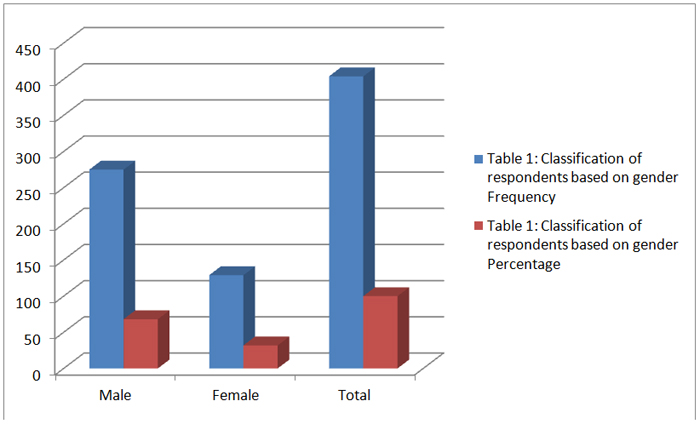
Graph-1: Gender wise classification of respondents
Analysis : According to the result obtained from table 1 and graph – 1, out of 404 respondents 275 (68.1%) are male respondents and 129 (31.9%) are female respondents are included in the study.
Table-2 : Classification of respondents on the basis of Age |
||
| Age | Frequency | Percentage |
| 16 – 25 | 193 | 47.8 |
| 26 – 35 | 100 | 24.8 |
| 36 – 45 | 60 | 14.9 |
| more then 45 | 51 | 12.6 |
| Total | 404 | 100 |
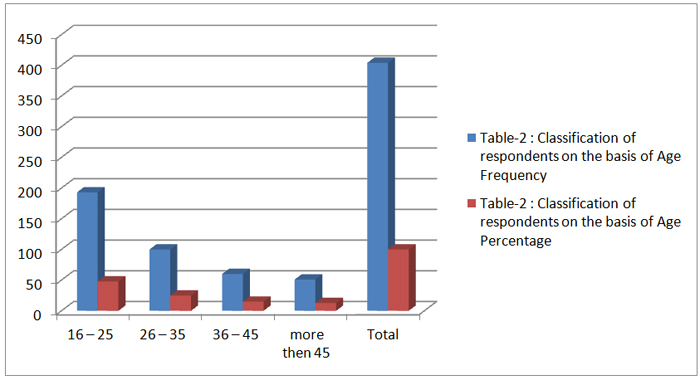
Graph-2 : Classification of respondents on the basis of age
Analysis: On the basis of age group, male and female respondents were divided into four age groups. According to the results obtained from Table No. 2, 47.8 percent of youth in the age group of 16-25 years participated in the study. Where as 24.8 percent of the respondents are in the age group of 26-35 years. In the presented research, 14.9 percent of the respondents are in the age group of 36-45 years. Along with this, information has also been collected from 12.6 percent of the respondents in the age group of more than 45 years.
Analysis of the platform used to read news
The media habits of the readers of Hindi news websites have been analyzed on the basis of frequency and percentage.
| Table-3: Analysis of platforms used for reading news | ||
| Use of platform to read news using internet (multiple choice) | Frequency | Percentage |
| Newspaper Website | 243 | 60.1 |
| Independent News Website | 66 | 16.3 |
| News App | 244 | 60.4 |
| Social Media | 191 | 47.3 |
| 80 | 19.8 | |
| E-Paper | 87 | 21.5 |
| All of the above | 112 | 27.7 |
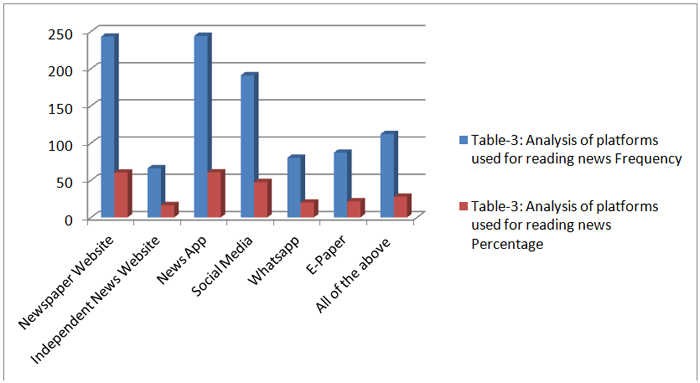
Graph-3: Analysis of platforms used to read news
Analysis: According to the results of Table-3 above, the highest 60.4 percent of the respondents chose the news app option for reading news using the internet. At the same time, 60.1 percent of the respondents also chose the news website. 47.3 percent of the respondents said that reading news through social media is their choice. The other two major platforms e-paper and WhatsApp are used by 21.5 and 19.8 percent of the respondents respectively to read news. At the same time, 16.3 percent of the respondents use independent news websites to read news. There are also 27.7 respondents who use all the above mediums to read news. It is worth mentioning that the format of the news website and its app is almost the same. The same news is published on both. The website is developed as an app for easy use on mobile devices. Thus, it is clear from the above analysis that readers are using the website more to read news.
Duration of use of news website
| Table-4 : Duration of use of news website | ||
| Watching Time | Frequency | Percentage |
| Once in a day | 111 | 27.5 |
| Many time in a day | 186 | 46 |
| Once in a week | 36 | 8.9 |
| Any time in a week | 71 | 17.6 |
| Total | 404 | 100 |
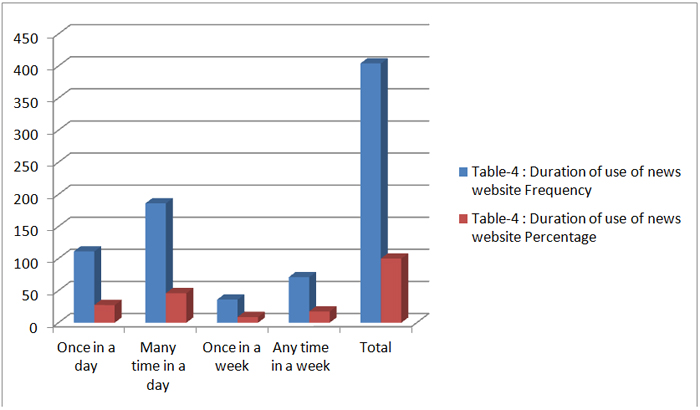
Graph-4: Usage duration of news website
Analysis: As per the data shown in above graph-4, 46 percent of the respondents have accepted the use of news website to read news several times in a day. Whereas, the number of users who read news in news website once a day is 27.5. 17.6 respondents use news website sometimes in a week. Whereas, 8.9 percent of the respondents use news website to read news once in a week. It is clear that readers visit and use the website repeatedly to read or get news.
Readers’ habits on advertisements displayed on the website
To know the habits and reaction of readers towards advertisements displayed on news website, they were asked the question “Do you click on the advertisements displayed on Hindi news websites and see them?” The opinion of the respondents received in response to this question has been studied on the basis of frequency and percentage.
| Table-5 : Readers’ habits towards displayed advertisements | ||
| Clicking on Ads | Frequency | Percentage |
| Yes | 61 | 15.1 |
| No | 139 | 34.4 |
| Sometimes | 154 | 38.1 |
| Never | 50 | 12.4 |
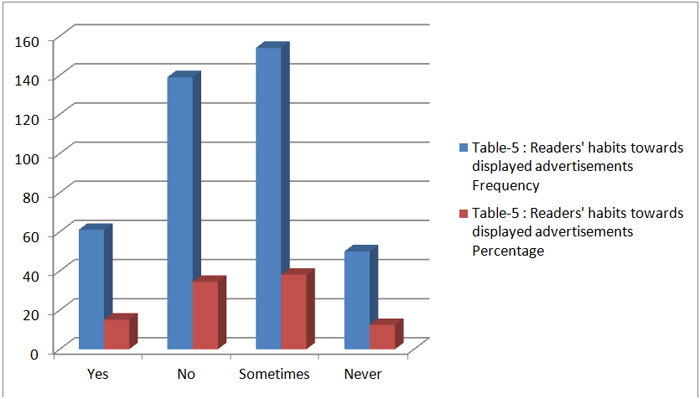
Graph-5 : Readers’ habit towards displayed advertisements
Analysis: According to the data shown in Table-5 and Graph-5 above, 38.1 percent of the respondents sometimes click on the advertisements displayed on Hindi news websites. Whereas, 15.1 percent of the respondents click on the advertisements displayed on Hindi news websites. Whereas, 34.4 percent of the respondents do not click on these advertisements. Whereas, there are 12.4 percent of the respondents who never click on these advertisements. It is clear from these figures that most of the readers of Hindi news websites sometimes click on the advertisements and see them. One meaning of this can also be that when an advertisement appears to be of their interest, then they click on it to get more information or to buy it. There are also a large number of readers who do not click on the advertisements. If we look at 34.4 and 12.4 percent together, then 46.8 percent of the readers do not click on the advertisements displayed on the website and see them.
Readers’ attitude towards advertisements displayed on the website:
To know the readers’ attitude towards advertisements displayed on news websites, the respondents were asked a question, “Do advertisements cause interruption in reading news while reading online?” The opinions of the respondents in response to this question have been studied on the basis of frequency and percentage.
| Table-6 : Attitude of readers towards advertisements displayed on the website | ||
| Disruption in online news | Frequency | Percentage |
| Yes | 224 | 55.4 |
| No | 41 | 10.1 |
| Sometimes | 127 | 31.4 |
| Never | 12 | 3.1 |
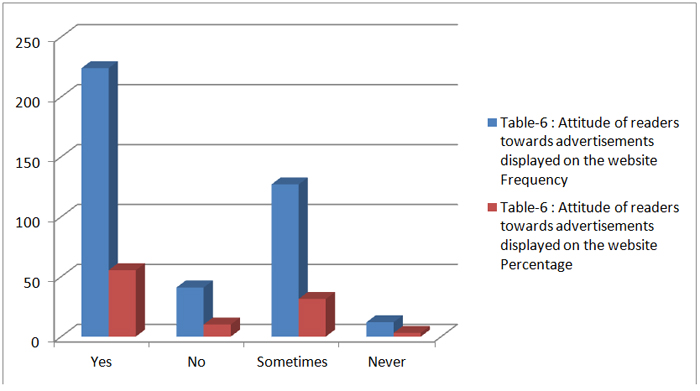
Graph-6: Readers’ view on advertisements displayed on the website
Analysis: As per the above table-6 and graph-6, 55.4 percent of the readers of Hindi news websites believe that while reading online news, the advertisements displayed interrupt the reading of news. 31.4 percent of the respondents say that these interrupt sometimes. Whereas, 10.1 percent of the respondents believe that advertisements do not interrupt the reading of news. Whereas, 3.1 percent of the respondents believe that these never interrupt the reading of news. It is clear that the reader sees the advertisements displayed on news websites as an interruption in reading news.
Study of readers’ habits and attitude towards advertisements displayed on the website on the basis of gender
The study of readers’ habits and attitude towards advertisements displayed on the Hindi news website has been done on the basis of gender in Table-7. Along with this, significant value (P) has also been measured through cross tabulation and chi square test (X2) to know the relation of readers’ attitude towards advertisements displayed on the website with their gender. In the following table, the degree of freedom (K) value is 3 as per the calculation done through SPSS software.
| Table 7: Study of readers’ habits and attitudes towards Advertisements displayed on the website on the basis of Gender | |||||||
| Factor | Gender | Yes | No | Sometimes | Never | X2 | P Value |
| Click on ads
|
Male – 275 | 48 | 97 | 97 | 33 | 5.282 | 0.152 |
| Female – 129 | 13 | 42 | 57 | 17 | |||
| Consider ads as an interruption | Male – 275 | 150 | 31 | 86 | 8 | 1.217 | 0.749 |
| Female – 129 | 74 | 10 | 41 | 4 | |||
Analysis: As per the statistics of Chi Square test in the above table-7, at a significance level of 0.05, the attitude of readers to click on the advertisements displayed on the Hindi news website and view them is not related to gender. Also, the attitude of considering the display of advertisements as an interruption while reading the news is also not related to gender. That is, the habit of clicking on the advertisements is not very common among the readers, and there is no statistically significant difference between men and women in this habit. Similarly, considering advertisements as an interruption is a widespread perception among readers (both men and women), and there is no statistically significant difference on the basis of gender in this perception.
Hypothesis Result for H₀₁:
H₀₁: There is no significant difference in the habits of readers towards clicking on advertisements displayed on Hindi news websites based on demographic factors such as gender and age.
Result:
The results of the Chi-Square test (Table-7) indicate that at the 0.05 level of significance, there is no statistically significant relationship between gender and the habit of clicking on advertisements displayed on Hindi news websites. Furthermore, the perception of advertisements as interruptions while reading news content also shows no significant difference across gender. Therefore, the null hypothesis (H₀₁) is accepted.
This implies that both male and female readers exhibit similar habits regarding interaction with advertisements, and the view that advertisements interrupt the reading experience is commonly held across gender groups.
Study of the habit and attitude of readers towards the advertisements displayed on the website on the basis of age
The habit and attitude of readers towards the advertisements displayed on the Hindi news website has been studied on the basis of age in Table-8. Also, through cross tabulation and chi square test (X2), significant value (P) has been measured to know the relation between the attitude of readers towards the advertisement displayed on the website and their age. In the following table, the degree of freedom (K) value is 3 as per the calculation done through SPSS software.
| Table – 8 : Study of readers’ habits and attitude towards Advertisements displayed on the website on the basis of Age | |||||||
| Factor | Age | Yes | No | Sometime | Never | X2 | P Value |
| Click on ads
|
16 – 25 | 28 | 59 | 80 | 26 | 10.377 | 0.321 |
| 26 – 35 | 21 | 32 | 34 | 13 | |||
| 36 – 45 | 7 | 24 | 24 | 5 | |||
| more then 45 | 5 | 24 | 16 | 6 | |||
| Consider ads as an interruption | 16 – 25 | 109 | 23 | 58 | 3 | 12.612 | 0.181 |
| 26 – 35 | 46 | 10 | 39 | 5 | |||
| 36 – 45 | 33 | 5 | 20 | 2 | |||
| more then 45 | 36 | 3 | 10 | 2 | |||
Analysis: As per the statistics of Chi Square Test in the above table, as the P-value (0.321) is significantly greater than 0.05, it shows that there is no statistically significant difference in the habit of clicking on advertisements among the age-groups. This means that, from a statistical point of view, the habits of clicking on advertisements of people of different age-groups do not differ significantly from each other.
Similarly, there is no statistically significant difference in the perception of advertisements as an interruption among the age-groups as here also the P-value (0.181) is also greater than 0.05. This implies that whether the reader is young or old, they have a similar attitude of considering the advertisements displayed while reading news on a news website as an interruption in reading the news.
Hypothesis Result for H₀₂:
H₀₂ (Null Hypothesis): There is no significant difference in the habit of clicking on advertisements displayed on Hindi news websites across different age groups.
Result:
The results of the Chi-Square Test indicate that the P-value (0.321) is greater than the significance level of 0.05, suggesting that the null hypothesis (H₀₂) is accepted. This means there is no statistically significant difference in the habit of clicking on advertisements among readers of different age groups. In other words, age does not play a significant role in determining whether a reader clicks on advertisements displayed on Hindi news websites.
Additionally, the analysis shows that the perception of advertisements as interruptions while reading news content also does not significantly differ across age groups (P-value = 0.181 > 0.05). This suggests a common attitude among both younger and older readers that advertisements disrupt the news-reading experience.
Conclusion and Discussion
The following conclusions emerge from the above research study:
- Readers use both websites and apps almost equally to read news. Advertising companies should make their strategy in such a way that their advertisements are compatible with the website as well as the app.
- Readers spend more time on news websites. They visit the website several times a day to get news. This result can help advertisers in making their strategy.
- Most readers of Hindi news websites sometimes click on advertisements and see them. One meaning of this can also be that when an advertisement appears to be of their interest, they click on it to get more information or to buy it.
- Among the readers of Hindi news websites, 55.4 percent of the respondents believe that while reading news online, the advertisements displayed interrupt the reading of the news. 31.4 percent of the respondents say that these interrupt sometimes. It is clear that the reader sees the advertisements displayed on news websites as an interruption in reading the news.
- The attitude of readers to click, watch or not watch advertisements displayed on news websites is almost the same for men and women. Most readers, especially women, pay attention or react to advertisements only ‘sometimes’, which shows their selective behaviour. The percentage of ‘yes’ and ‘no’ responses are slightly higher among male readers, while the tendency of ‘sometimes’ is stronger among women. This analysis can be important for advertisers and website owners so that they can customize their advertising strategies according to the habits and gender-based responses of readers.
- Most readers (both men and women almost equally) see the display of advertisements on news websites as a hindrance in reading the news. This breaks the sequence of reading the news and also causes inconvenience. Based on this result, advertising companies and news website operators can make their strategy to display advertisements at such a place, so that readers do not get interrupted while reading the news.
References:
- Dwivedi, A. (2024). Vigyapan Ka Jadu (First ed.). New Delhi: Kitabghar Prakashan.
- Kuthiala, B. (2010, July-September). Content analysis method-An introduction. Media Mimansa, 46.
- Martinez-Costa, M.-d.-P., Serrano-Puche, J., Portilla, I., & Sanchez-Blanco, C. (2019, 04 01). Young adults’ interaction with online news. Comunicar, 27(59), 19-28. doi:https://doi.org/10.3916/C59-2019-02
- (2025, February 7). advertisement. Retrieved July 25, 2025, from Samachar4Media.com: https://www.samachar4media.com/advertisement-news/digital-adex-sees-21-percent-growth-in-2024-tv-print-and-radio-decline-65557.html
- Samar, S. (2023, March 31). Drishti IAS Blog. Retrieved July 20, 2025, from Drishti The Vision: https://www.drishtiias.com/hindi/blog/impact-of-advertisements-on-consumers
- (2015, January 1). Bernard Berelson A Content Analysis Media Essay. Retrieved August 16, 2024, from UKEssays: https://www.ukessays.com/essays/media/bernard-berelson-a-content-analysis-media-essay.php
- Vivek, S. (2024). Prastavna. In D. A. Dwivedi, Vigyapan Ka Jadu (First ed., p. 11). New Delhi: Kitabghar Prakashan.
[1] Assistant Professor, Makhanlal Chaturvedi National Journalism and Communication University, Bhopal, e-mail: lokendra@mcu.ac.in, Mobile: 9893072930
[2] Assistant Professor, Makhanlal Chaturvedi National Journalism and Communication University, Bhopal, e-mail: gajendra@mcu.ac.in Mobile: 9827791007