
Decoding Indian Social and Cultural Cues in Dove Brand Advertising: A Rhetorical Approach
Kirti Khanna [1]
Dr Amita [2]
Abstract
Information bombarding has forced brands to experiment and innovate more communication channels. Catchy lines, purposeful drive is now what brands pitch after consumer analysis, their buying behaviour, market sensitivity, stereotype, their habits This research article focuses on deconstructing the social and cultural cues embedded in the dove brand ad campaign #Stop The BeautyTest and #TheBeautyTestStopsWithMe. The advertising policy of the brand which is based on female gaze, breaking of gender stereotypes, is analysed through the lens of rhetorical analysis; the three modes of persuasion given by Aristotle explained in a theoretical framework by Alkhirbash. The official you tube channel of Dove India is used as a platform to fetch ads. The findings reveal hierarchies, authority, dominance, passing the generational trauma is majorly done by females. This campaign also highlights the childhood conditioning and later on mothers acting as a shield for their daughter shows the shift from passing the psychological trauma to protecting from the same
Keywords: Advertising, Cultural, Dove Brand, Gender Stereotype, Social, Rhetoric Analysis,
Introduction
Information overflowing has urged brands to discover ways to stay in the consumer point of view while making the buying decision. Advertisement has become an integral part of modern society. It is no longer a bridge between brand (company) and consumer, rather has become a driving force of cultural representation and reality checks. Subtle socio-cultural impact of contemporary advertisements is one of the major reasons for brands to take a bold step and switch from marketing to everyday social life. Advertisements reflect the society as well as shape consumer buying conscience by broadcasting a certain type of lifestyle; Emile Durkheim in 1893 defined culture as a shared system of collective representation. His idea of society is reality in its own right. G.M Mead understood society as an exchange of gestures through symbols. Max Weber in 1905, emphasized on the role of religion and value in shaping the meaning of the society. As per V.I. Karasik, advertisements fall in the category of institutional discourse, and it is a specialized form of communication not governed by personal whim but through pre-defined and power dynamics of the society (Abdullaev, 2021).
Brands that use female advertising have an affirmative effect on the brands. Such advertisements highly influence consumers who show a positive attitude toward women (Fohlet.al, 2025). In a world where all the brands are focusing on getting a picture perfect image of women Dove came up with the concept of embracing the way one is. The ads show women not breaking stereotypes but embracing themselves by not fitting into the societal frames of beauty. Often commercials material in the society. Dove has excelled in real representation of women by breaking gender stereotypes. As per a study done by Dove which was shown in the commercial #Showus states that 70% of the women do not see themselves represented in the media. To overcome this hurdle Dove collaborated with Gaze Gritty Images to build a gallery of 5000 women breaking stereotypes. Dove’s marketing strategy has helped it grow from $2.5 billion to $7.1 billion in 2023. Dove is also committed to showing real women and is not involved in digital distortion or AI generated images. #StopTheBeautyTest was launched in 2021 after a research by Dove that 9 out of 10 women felt judged during marriage alliance talks and 3 out of 4 women were ‘rejected’ for their physical appearance (height, skin tone, hair, weight, skin texture, birth, scars, etc.)
Rationale of the study
Huang C. et.al, applied Aristotelian rhetorical devices of Pathos, Ethos and Logos in green brand storytelling in order to understand if the consumers perceived value (CPV) has any effect between the three persuasion techniques used in green brand stories and assumed brand sincerity. They also tried to identify the role played by the need for cognition (Huang. et.al, 2022). Using quantitative techniques the findings were that the advertisements are evolving at a tremendous pace, now brands have understood that using catchy tag lines, bright colors and product centered ad has to be altered with social issues, reality and consumer-centric approach resulted through positive effects in pathos and ethos. There is a need for detailed study from the qualitative point of view to understand the reflection of Indian society at a niche level and particular focus on one ad/campaign from one brand. This study tries to fill that gap.
Review of Literature
Patil (2026), analysed the brand storytelling on digital media platforms and found that it has brought a shift in the way brands interact with consumers. Storytelling has ended the conventional one-way communication to consumer-driven, value loaded, authentic narratives. Bringing consumer’s daily routine and real-life chaos into the advertisements has brought brands closer to consumers. Interactive, Personalized and experientiality are some of the elements given by digital media to brand storytelling. Meral, Bozkurt, and Uğursoy (2025)semiotically interpreted the McDonald’s Turkish ad. The conclusions drawn on the fact that international brand McDonal has carefully and intelligently embedded cultural values, norms, rituals and symbolic places of turkey in their advertisement. Brands build emotional bonds through cultural codes which security engages their consumers. McDonald’s turkey ad gave us insight that adding cultural codes to the ad gives consumer loyalty and market success. Varghese and Kumar (2022),in their study on femvertising (female centric advertisements), found out trends used by brands through (i) positive representation of female, (ii) focusing on brand activism, cultural marketing and conscious buying (iii) avoiding commodifying females and (iv) analyzing gender representational stereotypes existing in the society. They analyzed and categorised femvertising in different waves, and the pro-feminism which is contemporary is associated with the fourth wave of feminism.Chang (2021) Talking about abstract ads narrative ads are more effective than argument advertisements, as it helps consumers to induce association as they imagine themselves in the scenario. Consumers develop this association through pre-stored stimuli to correspond to the narrative prototypes this help in increasing the effectiveness of the advertisement. Minar (2016),on contemporary ads found out that today’s brands are now involved in making stories than ads. This change was exclusively driven by Millennials. This generation brought complete and complex changes in the economical, societal, political arena. They started demanding ‘purpose’ from the corporations and companies and ultimately preferring to the brands that care. He used the term ‘goodvertising’ in his study to highlight the purpose of brands through advertisement; overall betterment of the society.
Research Questions
This research articles tries to answer following question:
- How Aristotelian rhetorical devices are incorporated in Dove Brand commercials?
- What social and cultural cues of Indian society are reflected in Dove Brand commercials?
Purpose of the Study
The purpose of this study is to evaluate the role of social and cultural codes in advertising communication through a means of storytelling. Cultural codes represented through language, values, customs, belief (Akolkar et.al, 2024) and hierarchies in the Dove ad answer the ‘how’ question. Where culture studies a deeper meaning, social cues are more direct and clearly visible in ads through interaction, set up, and visual elements answering the ‘what’ question (Giaccardi, 1995).
Research Methodology
This study applies the qualitative content analysis technique. The source of data are the advertisements from the campaigns #StoptheBeautyTestand #TheBeautyTestStopsWithMe available on official Dove India YouTube channel. Six ads were taken for this study purpose with a total duration of 7 minutes and 5 minutes (approx.) respectively. The ads in English, Hindi or any other vernacular language but with English subtitles were considered for this study. As Dove aims to cast real persons, personally sharing their real stories and lived experiences in their mother tongue, it was decided to take subtitles into consideration. For easy comprehension the two campaigns consist of three ads, the first ad reflects young girls getting ready for an arranged marriage meetup (coded as A1). Second ads give an idea of what teenagers struggle with to fit in the Indian beauty standard (coded as A2). Lastly, mothers strongly shield their daughter ad (coded as A3).
In the process of analysing the data the researchers downloaded the ads from the official channel, then after multiple viewing of the ads beginning, middle and end of the ads were described as the initial part of storytelling analysis. At the second stage elements of Digital Storytelling were carefully written down. Highlighting elements of society as a sense of likeness and diversity as defined by McIver & Page, interdependence, authority and mutual aid. Identifying culture as values, norms, sanction and traits and finally all these elements were aligned and analysed on the basis of the codes developed from the lens of Three Modes of Persuasion by Aristotle (Rhetorical); Pathos – Emotions of the audience; Ethos – Authenticity of the speaker/character; and Logos – Believable arguments by orator; as a theoretical framework (mentioned in table below). These were further elaborated and supported by the detailed framework on Aristotle’s mode of persuasion by Alkhirbash (Alkhirbash, 2008) .
| Means of persuasion (Given by Aristotle) | Operational Definition | Qualities/Instruments (Provided by Alkhirbash) |
| Ethos | Ethos depends on the character of the speaker. Whenever the speaker appears worthy of credence, the audience accept his prepositions and consider them true and credible. | ● Good Sense (Credibility of speaker)
● Good Moral Character (Unbiased speaker) ● Goodwill (Altruistic nature of speaker ) |
| Logos | Logos is appeals to reason and logical proof with facts, example reflecting the universe | ● Reasons (Claim to support argument)
● Facts ● Enthymemes (Persuasion tool but without absolute certainty of truth) ● Example ● Rhetorical Question (To Stimulate listeners’ logical thinking) ● Statistics (Using Numbers to supports data) ● Statement from Authorities (Stating expert opinion) ● Syllogism (Conclusion from provided premises) |
| Pathos | Pathos is a persuasive means to arouse the emotion of the audience to change their opinion in regard to their judgement | ● Empathy
● Anger ● Sorrow ● Compassion ● Fear ● Love ● Pride |
Table no. I
Discussion
Most of the Dove ads are motive driven talking about breaking gender stereotypes. The philosophical aim of the brand opted for ads that are not only changing the perception of the women in the society, but also positive acceptance in their own minds. The brand realized that women miss out from the ads which expose them to larger audiences, or they go through low self-esteem because they have been exposed to beauty standards in which they don’t find themselves fit. The idea of beauty they have grown into and are surrounded by is all about a physically fit body, fair skin tone, straight hair, good height. To answer this identity crisis Dove ideated on embracing oneself as one is. The mission of both the campaigns taken up for study is like a journey, one where one campaign shows the harsh reality faced by every other woman in our society to come up with mothers who now stand as a tall wall between their daughters and judgemental society. Mothers who refuse to present their daughters on the marriage platters. These campaigns are different and not to be understood as continuum but are about stopping the unnecessary judgements and questions from women and treating her as if she has no say in any decision about herself.
The ad campaign #StopTheBeautyTest was launched by Ogilvy in the year 2021, to understand how brands are involved to localize themselves to penetrate into a society. Here, the brand chose five real women who faced social evil of judgement. They have taken up one of the most evil Indian rituals, ideas of arranged marriage meeting set ups.
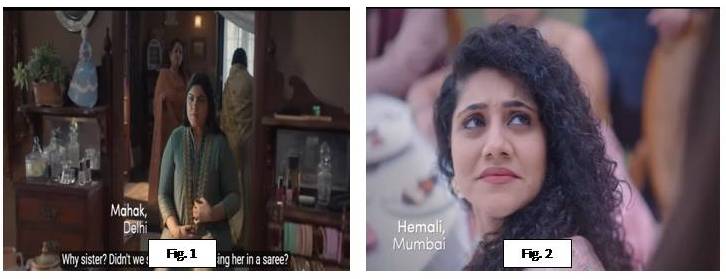
So decoding the campaign #StopTheBeautyTest story line. The ad opens with a tag line narrating the story of every other girl of the country. The ad begins with a provocation where young females meet a boy and his family for an arranged marriage, where they are to be judged for their physical appearance (weight, skin tone, hair, height).
Soft music is being added in the background. The setting is either domestic or outdoor but usually in the presence of close family members. There are more females who are openly involved in the conversation and pointing out flaws in the females, mocking their natural appearance in front of girl’s family members.
The social codes decoded that women are forced to fit in the frame of marriage structure. They are judged for their hair, height, questioned about skin color or any marks on the skin, asked to cover their extra weight, the notable point is all this is done by a woman. Family members instead of defending or supporting their daughters remain silent and become a mere audience (Fig. no. 1 to Fig. no.5).
Dove brand moved a step forward and launched the second phase of the campaign just before daughters day a year later. Focusing on the root cause of the judgements under the tag line The Beauty Report Card. This ad states it all starts at a very tender age.
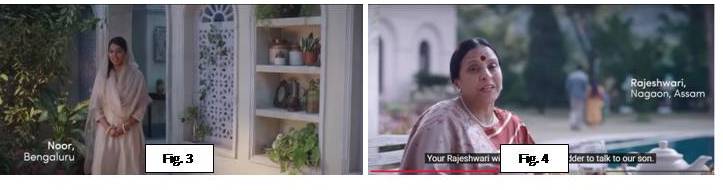
Ad shows school going teenage girls are forced to change themselves and are moulded as per the societal beauty standards by their own family members and teachers. They are conditioned to fit themselves in the fixed beauty system by females around them, mother, grandmother, sister, and teachers. These girls remain quiet throughout the ad, think that the mirror is a beauty burden, background narration speaks as their inner voice. At the end of the ad they quietly rebel by doing what they like.
Dove integrated with UNICEF’s Self-Esteem project to reach 8 million girls by 2025 and help them in building body-positivity and body-confidence. (Fig no. 6 to fig. no. 10)
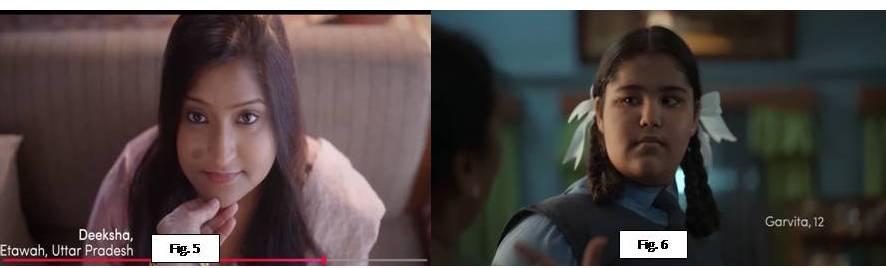
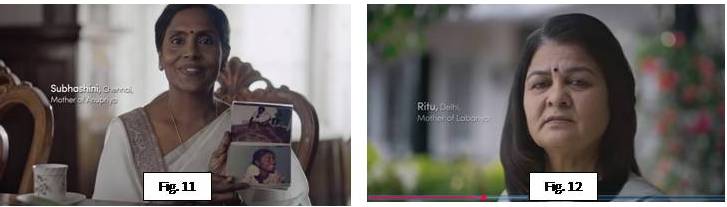
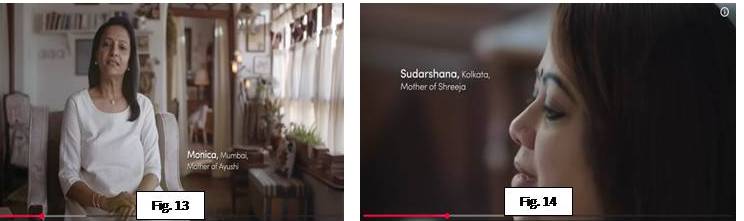
The last stage of this campaign #TheBeautyTestStopsWithMe is a strong institutional message through mothers protecting their daughters. They highlighted their daughter’s achievements and professions rather fitting into the set beauty frame. The ad opened with a comment that they remembered receiving during their marriage alliances years back.
Findings and Analysis
The social and cultural codes reflected in the first two stages of the campaign highlight a strong presence of hierarchies. Grandmother, mother, elder sister or teachers dominate the decision-making process. They act as a judge when it comes to women. Findings of interrelations reveal that the Indian society is patrilineal and male dominating but the bars of patrilineality are strongly held by females. This is made clear that all the judging and mocking the women gets is from females. Absence of family members to support them, they question themselves, their natural appearance, deep down they know it is the looks instead of skills they will be judged for or their family has to compromise for not fitting into the frame of beauty. Women find it hard to accept themselves as the way they’re.
The last stage of the campaign states mothermonials rather than matrimonials. Where mothers positively dominate the decision-making process but this time strongly supporting their daughters. Mothers set benchmarks and conditions for potential males and affirms only to marry if they are strong enough to bear their daughter’s skill. Mothers stand a tough wall between society and their daughters. Presence of positive hierarchies as mother not passing generational trauma, strong female authority.
The Dove brand has succeeded in highlighting a cultural dialogue hard to face. The brand did not use direct product placement instead acted as an interventional thought-provoking idea of fighting the crisis of confidence in the majority of Indian women. The tabular explanation provided below explains through the lens of the proposed framework. All the three ads discussed above are analyzed using the theoretical framework:
|
Means of Persuasion |
Qualities |
Analysis of the campaigns |
|
Ethos |
Good Sense
|
Ye sirfhumarinahideshkikarodonladkiyokikahanihai (This is not only our story, it belongs to millions of girls of this country).(A1,A2)
Putting conditions on desirability of grooms rather than brides.(A3)
|
|
Good Moral Character |
||
|
Goodwill |
||
|
Logos |
Reasons | Insecurity among females because they are judged solely on the basis of their physical appearance. (A1,A2) |
|
Facts |
Women are expected to be prefect (A1,A2, A3) |
|
|
Enthymemes |
women judged on the basis of their physical appearance (A1,A2, A3) |
|
|
Example |
Mothers themselves victim of societal beauty standards and they refuse the same for their daughters (A3) |
|
|
Rhetorical Question |
How much beauty is enough?(A1,A2) |
|
|
Statistics |
9 out of 10 women felt judged for marriage; 3 out of 4 were rejected due to physical appearance (A1,A3) |
|
|
Statement from Authorities |
Mothers are authority (A3) |
|
|
Syllogism |
Females are judged and demoralised by females. (A1,A2) |
|
|
Pathos |
Empathy |
Instigated/Aroused through no dialogue from school going girls or aspiring brides |
|
Anger |
Instigated/Aroused through action of school girls, coldly refusing to fit in the pre-set beauty frame (A2) |
|
|
Sorrow |
Embedded in characters expressed through facial expressions (A1,A2) |
|
|
Compassion |
Instigated/Aroused- Mothers standing for daughters (A3) |
|
|
Fear |
Instigated/Aroused- rejection among aspiring brides, burden of dowry on family in school girls (A1,A2) |
|
|
Love |
Mother expressing their love for daughters (A3) |
|
| Pride |
Mothers proud about daughter’s achievement and highlighting her skills (A3) |
Table no. II
Conclusion
The ad campaign #StopTheBeautyTestand #TheBeautyTestStopsWithMeis an evident intervention of reality of Indian marriages. Dove is subverting to deeply penetrated codes that view the social worth of a female by her physical appearance. The brand has succeeded in highlighting the source of psychological trauma of a woman since a young age. This campaign by the brand shifts the marriage grammar and positions itself as a reformer.
References
- Abdullaev, B. (2021), Factors determining the Place of Discourse in Advertising Text and Its Influence on the Social Structure, Galaxy International Interdisciplinary Research Journal, Vol. 9, Issue.9, https://www.neliti.com/publications/596672/factors-determining-the-place-of-discourse-in-advertising-text-and-its-influence
- Akolkar, A.H., N, Sai., V. Sai., Upparu, N.R., Khan, E., (2024), Cultural Differences Affecting Advertising, International Research Journal of Economic and Management Studies, 3, Issue 10, Pg. No. 259-267 Doi: 10.56472/25835238/IRJEMS-V3I10P130
- Alkhirbash,A. (2016), A Proposed Framework for Analyzing Aristotle’s Three Modes of Persuasion, International Journal of English and Education, 5, Issue 4 ISSN: 2278-4012
- Buckley, A. C., Yannopoulou, N., Gorton, M., & Lie, S. (2024). Guilty Displeasures? How Gen-Z Women Perceive (In)AuthenticFemvertising Messages. Journal of Current Issues & Research in Advertising, 45(4), 388–401. https://doi.org/10.1080/10641734.2024.2305753
- Chang, C. (2012). Narrative Ads and Narrative Processing. In E. Thorson and S. Rodgers (Eds.), Advertising Theory (pp.241-254). New York: Routledge
- Dove India (2021) https://youtu.be/jEpTa2cMl_I?si=VnGIMRpH0754MnWJ
- Dove India (2022) https://youtu.be/1_OC29X41EE?si=-4CTI9sVyQ7Y7NVT
- Dove India (2024) https://youtu.be/tUEgKoXuE3Y?si=d2ValH5LdZz61uhR
- Escalas,J.E. (2008) Narrative Processing: Building Consumer Connections to Brands, Journal of Consumer Psychology,14, Issue 1-2, Pg.No-168-180
- Föhl, U., Sander, F., Walter, N., & Zimmermann, L. M. (2025). Beyond Gender Stereotypes! The Impact of Femvertising on Brand Attitude and the Moderating Role of Product Gender and Attitude Toward Feminism. Journal of Promotion Management, 31(4), 711–742. https://doi.org/10.1080/10496491.2025.2508148
- Giaccardi, C. (1995), Television Advertising and the Representation of Social Reality: A Comparative Study, Theory of Culture & Society (SAGE, London, Thousand Oaks and New Delhi) 12, Pg. No. 109-131
- Huang C, Zhuang S, Li Z and Gao J (2022) Creating a Sincere Sustainable Brand: The Application of Aristotle’s Rhetorical Theory to Green Brand Storytelling. Front. Psychol. 13:897281. doi: 10.3389/fpsyg.2022.897281
- P (2016), Goodvertising as a Paradigmatic Change in Contemporary Advertising and Corporate Strategy Communication Today, Vol. 7 No. 2, P. no. 4-17.
- Meral,P.S., Bozkurt,S., &Uğursoy, A.S., (2025), Semiotic Analysis of Cultural Codes in Personalized Brand Experiences: Reflections on Responsible Consumption in the Case of Mcdonald’sTurkey,Journal of Lifestyle and SDG’s, Review Florida, USA., Vol. 5, Pg.no, 01-17 https://doi.org/10.47172/2965-730X.SDGsReview.v5.n06.pe06938
- Patil, R.V (2026), Analysis of the Evolution of Brand Storytelling in Digital Media, IJIRT, Vol 12 Issue 8. ISSN: 2349-6002
- G, Edited (2015) Hand Book of Brand Semiotics, Kassel University Press, Germany, ISBN 978-3-7376-0043-9 (e-book) http://nbn-resolving.de/urn:nbn:de:0002-400435
- Schick. N, (2024), 20 years on: Dove and the future of Real Beauty, Unilever https://www.unilever.com/news/news-search/2024/20-years-on-dove-and-the-future-of-real-beauty/
- Terskikh,M., &Zaytseva, O., (2021), Ideological and Cultural Codes in Dove Brand Advertising: A Semiotic Analysis. European Proceedings of Social and Behavioural Sciences, doi: 10.15405/epsbs.2021.12.109
- Varghese, N., & Kumar, N. (2022). Feminism in advertising: Irony or revolution? A critical review of femvertising. Feminist Media Studies, 22(2), 441–459. https://doi.org/10.1080/14680777.2020.1825510
- Veliani,A., (2025). An Analysis of Ethos, Logos, and Pa thos Persuasion Strategies in Heejae Lim’s Speech