

FinTech adoption among Gen Z: Investigating the moderating role of Social Media Marketing
Manisha Verma[1]
Prof. Shuchi Srivastava[2]
Dr. Nenavath Sreenu[3]
Dr. Gyaneshwar Singh Kushwaha[4]
Abstract
The rapid expansion of FinTech (Financial Technology) services in India has revolutionized how individuals manage finances, especially among the youth demographic. With increased smartphone penetration, digital literacy, and active online engagement, young Indians are emerging as significant adopters of FinTech platforms. However, the role of social media marketing in shaping this adoption behaviour remains underexplored. This study investigates the adoption of FinTech services among Indian Gen Z using the Technology Acceptance Model (TAM), incorporating social media marketing as a moderating variable. Data was collected through a structured questionnaire, generating 267 valid responses from Indian Gen Z. The study employed Structural Equation Modeling (SEM) to analyse the relationship between key TAM constructs—Perceived Usefulness, Perceived Ease of Use, Attitude Toward Use, and Behavioural Intention to Use—and the moderating impact of social media marketing. The results confirm that social media marketing significantly enhances the effect of Perceived Usefulness and Attitude Toward Use on Behavioural Intention to adopt FinTech. This suggests that social media not only informs and influences youth financial behaviour but also fosters trust and positive perceptions toward emerging FinTech solutions. This research contributes to literature by integrating TAM with a marketing perspective and provides managerial insights for FinTech companies targeting Indian youth.
Keywords: FinTech adoption, Technology Acceptance Model, Gen Z, social media marketing, structural equation modeling.
- Introduction
1.1 Role of FinTech in Reshaping the Financial Landscape in India
Over the past decade, Indian financial ecosystem has undergone a profound transformation, largely propelled by the rapid growth of Financial Technology (FinTech). The convergence of digital innovation, widespread mobile access, and government-led initiatives—such as Digital India, Jan Dhan Yojana, and the Unified Payments Interface (UPI)—has positioned FinTech as a key driver of financial inclusion and economic empowerment. By offering faster, more affordable, and easily accessible financial services, FinTech has disrupted traditional banking models across domains like payments, lending, wealth management, and insurance.
This shift is particularly evident among Gen Z, who, as digital natives, prioritize convenience, personalization, and speed in their financial transactions. The widespread availability of smartphones, low-cost internet, and intuitive tech platforms has significantly reduced barriers to financial access. As a result, FinTech is increasingly viewed not as an alternative but as a mainstream channel for managing personal finances in India. Social media platforms have played a crucial role in shaping perceptions and building trust in digital financial services—especially among younger users—through targeted campaigns, influencer engagement, and compelling brand narratives.
Indian youth, especially Gen Z, are emerging as the leading adopters of FinTech, driven by their high digital literacy and mobile-first habits. This demographic is highly responsive to innovations that align with their lifestyle preferences and financial aspirations. Unlike previous generations, they readily embrace mobile-based financial tools—from digital payments and banking to investments and credit—often favouring FinTech platforms over traditional banking channels. Companies like Paytm, PhonePe, Google Pay, and Cred have successfully captured this market by offering user-friendly interfaces, loyalty rewards, and personalized services. Moreover, the rise of financial education, gamified investment platforms such as Zerodha and Groww, and increasing smartphone penetration have further solidified FinTech as the default mode of financial engagement for this generation.
- Literature Review
2.1 Introduction to FinTech Adoption
Financial Technology (FinTech) has fundamentally transformed the delivery and accessibility of financial services. It encompasses a wide array of innovations, including mobile banking, peer-to-peer lending, digital wallets, and cryptocurrencies (Arner et al., 2015). In India, the rapid surge in smartphone adoption and internet connectivity has accelerated the growth of the FinTech sector, particularly among younger users.
Research indicates that key factors influencing FinTech adoption in India include ease of use, trust, perceived usefulness, and digital literacy (Sharma & Goyal, 2022). The Technology Acceptance Model (TAM), introduced by Davis (1989), continues to serve as a foundational framework for understanding user behaviour and intention toward technology adoption. According to TAM, perceived ease of use (PEOU) and perceived usefulness (PU) are critical determinants of an individual’s willingness to embrace new technologies. In recent years, scholars have expanded the model to incorporate additional constructs such as trust, perceived risk, and social influence, offering a more nuanced understanding of FinTech adoption (Chuang et al., 2016; Alalwan et al., 2018).
2.2 Gen Z as Digital Natives
Generation Z constitutes the most digitally engaged demographic in India. As reported by the Internet and Mobile Association of India (IAMAI, 2023), more than 60% of the country’s internet users belong to this age group, positioning them as a crucial audience for FinTech providers. Often described as “digital natives,” Gen Z demonstrates a strong affinity for emerging technologies, especially mobile applications that facilitate banking, investing, insurance, and payment services (Gupta & Arora, 2020).
Studies suggest that Indian youth not only adopt FinTech solutions early but also play a pivotal role in shaping digital trends within their social circles (Mittal & Goyal, 2021). Their preferences are influenced by factors such as ease of access, transaction speed, peer recommendations, and digital marketing efforts. Additionally, this cohort shows heightened engagement with app-based platforms that incorporate gamified experiences and interactive features—elements that are increasingly embedded in contemporary FinTech products.
2.3 Social Media Marketing and Its Influence
Platforms like Instagram, YouTube, and LinkedIn have become powerful channels for shaping consumer attitudes and behaviours. Social media marketing (SMM) involves the strategic use of these platforms to enhance brand visibility, foster trust, and encourage user interaction. Within the financial services sector, SMM has gained traction for its ability to establish credibility and demystify complex financial topics through influencer-led content and concise, engaging formats (Kapoor et al., 2020).
Emerging research underscores the critical role of SMM in promoting FinTech solutions. For instance, Chen et al. (2019) observed that social media influencers significantly influence trust levels in mobile payment applications among Gen Z users. Likewise, Pradhan et al. (2021) highlighted that the popularity of mobile wallet apps in India was closely tied to targeted promotional efforts on social platforms. Personalized content, dynamic visuals, and endorsements from trusted figures have been shown to directly shape consumer decision-making in the digital financial space.
2.4 Moderating Role of Social Media Marketing
The moderating influence of social media marketing (SMM) on FinTech adoption is an emerging area of examination. It is posited that SMM reinforces the relationship between perceived usefulness (PU) and perceived ease of use (PEOU) with users’ behavioral intention to adopt FinTech services. Strategic SMM initiatives can elevate the perceived credibility of FinTech applications, thereby amplifying the positive effects of PU and PEOU on adoption decisions (Zhou, 2011; Liu et al., 2022).
In the Indian context—where consumer trust is gradually transitioning from conventional financial institutions to digital platforms—social media serves as a conduit for reducing information asymmetry and fostering user engagement (Chatterjee et al., 2020). Among younger demographics, SMM not only raises awareness but also cultivates a sense of digital community, encouraging peer recommendations and interactive discussions that shape adoption behavior (Patil & Bansal, 2023). Furthermore, SMM aligns closely with the construct of social influence as outlined in the Unified Theory of Acceptance and Use of Technology (UTAUT), reinforcing normative pressures through mechanisms such as likes, shares, and comments that subtly guide user attitudes toward FinTech solutions.
While numerous empirical studies have explored FinTech adoption in India, relatively few have focused on youth behavior or the specific role of social media. Bhatt and Bhatt (2022) identified digital trust, perceived security, and mobile app usability as key determinants of FinTech usage among urban youth. Similarly, Raj and Aithal (2021) emphasized the importance of innovative marketing approaches to attract and retain young users in the FinTech ecosystem.
Recent findings by Jain et al. (2023) reveal that exposure to financial influencers on platforms like Instagram and YouTube significantly shapes investment decisions among young users, particularly in areas such as mutual funds and digital gold. These insights highlight the evolving role of SMM—not merely as a promotional tool, but as a catalyst for financial literacy and behavioral transformation.
3. Research Gaps
Although the literature on FinTech adoption has expanded considerably, there remains a notable gap in understanding the interactive effects of social media marketing (SMM) within the Indian youth demographic. While the Technology Acceptance Model (TAM) and its extensions have been extensively applied to study user behaviour, the moderating influence of digital marketing—particularly via social media platforms—has received limited scholarly attention. Moreover, much of the existing research tends to aggregate users across diverse age groups, thereby overlooking the distinct digital engagement patterns and financial attitudes characteristic of Gen-Z youth. This segment, with its high social media affinity and evolving trust dynamics, warrants focused investigation to uncover nuanced drivers of FinTech adoption.
3.1 Objectives of the study:
- To examine the factors influencing Gen Z’s adoption of FinTech services.
- To analyse the direct effect of perceived ease of use on behavioural intention among Gen-Z.
- To investigate the indirect relationship between Perceived usefulness and behavioural intention with the mediating effect of attitude.
- To access the moderating role of social media marketing in FinTech services adoption.
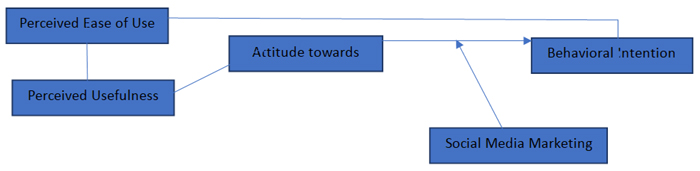
Fig:1 Conceptual Model
3.2 Model based hypotheses
H1: Perceived Ease of Use (PEOU) has a positive influence on Perceived Usefulness (PU).
H2: Perceived Usefulness (PU) has a positive influence on Attitude Toward Use (ATU).
H3: Attitude Toward Use (ATU) has a positive influence on Behavioural Intention (BI).
H4: Perceived Usefulness (PU) has a positive influence on Behavioural Intention (BI).
H5: Social Media Marketing (SMM) positively moderates the relationship between Perceived Usefulness (PU) and Behavioural Intention (BI).
- Research Methodology
4.1 Research design
This study employs a quantitative, descriptive research design, drawing on primary data collected through an online survey to examine FinTech adoption among Indian youth. A total of 267 valid responses were gathered from individuals aged 20 to 30 years, representing diverse regions across India. A purposive sampling technique was used to specifically target digitally engaged youth with prior exposure to FinTech services.
Data collection was facilitated through a structured questionnaire featuring items measured on a 5-point Likert scale. Constructs for Perceived Usefulness (PU), Perceived Ease of Use (PEOU), and Behavioural Intention (BI) were adapted from established literature within the Technology Acceptance Model (TAM) framework. In addition, the Social Media Marketing (SMM) construct was derived from validated consumer behaviour scales to evaluate its potential moderating role in influencing FinTech adoption.
4.2 Data and Results Analysis
Table 1: Demographic Profile of Respondents (N = 267)
| Demographic Variable | Category | Frequency (n) | Percentage (%) |
| Gender | Male | 145 | 54.3% |
| Female | 122 | 45.7% | |
| Age Group | 20–24 years | 157 | 58.8% |
| 25–30 years | 110 | 41.2% | |
| Education | Undergraduate | 108 | 40.4% |
| Postgraduate | 129 | 48.3% | |
| Others (Professional/PhD) | 30 | 11.3% | |
| Occupation | Student | 142 | 53.2% |
| Working Professional | 109 | 40.8% | |
| Entrepreneur/Freelancer | 16 | 6.0% | |
| FinTech Usage Frequency | Daily | 81 | 30.3% |
| Weekly | 112 | 41.9% | |
| Occasionally | 74 | 27.7% |
Table: 2 Measurement Model Assessment
|
The measurement model was evaluated to confirm the reliability and validity of the constructs employed in the study. Internal consistency was verified, with all constructs exhibiting Cronbach’s Alpha and Composite Reliability (CR) values exceeding the recommended threshold of 0.70.
Convergent validity was supported by Average Variance Extracted (AVE) values above 0.50 for each construct, indicating that the observed variables sufficiently capture the underlying latent constructs.
Discriminant validity was assessed using the Fornell-Larcker criterion. The square root of the AVE for each construct was found to be greater than its correlations with other constructs, thereby affirming the distinctiveness of each construct within the model.
Table 3 Structural Model Results (SEM Path Analysis)
| Path | Hypothesis | Path Coefficient (β) | p-value | Decision |
| PEOU → PU | H1 | 0.36 | < 0.01 | Supported |
| PU → ATU | H2 | 0.42 | < 0.01 | Supported |
| ATU → BI | H3 | 0.51 | < 0.001 | Supported |
| PU → BI | H4 | 0.28 | < 0.01 | Supported |
| SMM × PU → BI | H5 (moderation) | 0.22 | < 0.05 | Supported |
The structural model analysis provided empirical support for all five proposed hypotheses. Perceived Ease of Use (PEOU) demonstrated a significant positive effect on Perceived Usefulness (PU) (β = 0.36, p < 0.01), suggesting that users who find FinTech services user-friendly are more likely to perceive them as beneficial.
In turn, PU significantly influenced Attitude Toward Use (ATU) (β = 0.42, p < 0.01), while ATU emerged as a strong predictor of Behavioural Intention (BI) (β = 0.51, p < 0.001), indicating that a favourable attitude toward FinTech substantially enhances users’ intention to adopt such services.
Additionally, PU exerted a direct positive impact on BI (β = 0.28, p < 0.01), reinforcing the notion that perceived benefits drive adoption intentions. Notably, Social Media Marketing (SMM) significantly moderated the PU–BI relationship (β = 0.22, p < 0.05), highlighting that strategic social media engagement amplifies the effect of perceived usefulness on users’ behavioural intention to adopt FinTech services.
- Conclusion
The study concludes that FinTech adoption among Gen Z in India is significantly shaped by core constructs of the Technology Acceptance Model (TAM), namely Perceived Ease of Use (PEOU), Perceived Usefulness (PU), Attitude Toward Use (ATU), and Behavioural Intention (BI). All hypothesized relationships were found to be positive and statistically significant, indicating that Gen Z users are more inclined to adopt FinTech services when they perceive them as user-friendly and beneficial.
Importantly, the moderating role of Social Media Marketing (SMM) was validated, revealing that targeted and engaging social media strategies enhance the influence of perceived usefulness on behavioural intention. This underscores the strategic value of social media not only as a promotional channel but also as a trust-building mechanism in the digital financial ecosystem.
The findings highlight the necessity for FinTech providers to prioritize intuitive design and value-centric communication in their marketing efforts. Given Gen Z’s digital nativity, their financial decision-making is notably responsive to online stimuli and peer-driven content.
Overall, the research advances the understanding of behavioural dynamics among young digital consumers and offers actionable insights for FinTech marketers, developers, and policymakers aiming to foster greater adoption within this demographic.
References:
- Alalwan, A. A., Dwivedi, Y. K., & Rana, N. P. (2018). Digital banking adoption: A qualitative study. Journal of Retailing and Consumer Services, 45, 207–220.
- Arner, D. W., Barberis, J., & Buckley, R. P. (2015). The evolution of FinTech: A new post-crisis paradigm? Georgetown Journal of International Law, 47, 1271–1319.
- Bhatt, A., & Bhatt, R. (2022). Digital Financial Services Adoption by Indian Youth: Evidence from Urban Areas. Indian Journal of Finance, 16(2), 32–44.
- Chatterjee, S., Rana, N. P., & Dwivedi, Y. K. (2020). FinTech and social media: Examining the impact of social influence and social media usage on consumer adoption of digital wallets. Technological Forecasting and Social Change, 158, 120143.
- Chen, Y., Yan, X., Fan, W., & Gordon, M. (2019). The joint moderating role of trust propensity and gender on consumers’ online shopping behavior. Computers in Human Behavior, 93, 79–89.
- Davis, F. D. (1989). Perceived usefulness, perceived ease of use, and user acceptance of information technology. MIS Quarterly, 13(3), 319–340.
- Gupta, A., & Arora, A. (2020). FinTech adoption and Indian millennials: A structural equation modeling approach. Journal of Indian Business Research, 12(1), 61–83.
- (2023). Digital in India Report 2023. Internet and Mobile Association of India.
- Jain, N., Sharma, R., & Tripathi, R. (2023). Impact of financial influencers on FinTech investment decisions of Indian millennials. Asian Journal of Business Research, 13(1), 1–15.
- Kapoor, K. K., Tamilmani, K., Rana, N. P., Patil, P., Dwivedi, Y. K., & Nerur, S. (2020). Advances in social media research: Past, present and future. Information Systems Frontiers, 20(3), 531–558.
- Liu, Y., Lu, H., & Wu, X. (2022). Understanding FinTech adoption: A social media analytics approach. Electronic Commerce Research and Applications, 52, 101104.
- Mittal, S., & Goyal, A. (2021). Youth and digital finance: Understanding behavioral intentions toward FinTech platforms. Global Business Review. https://doi.org/10.1177/09721509211020403
- Patil, S., & Bansal, P. (2023). Influence of Social Media on Young Adults’ FinTech Behavior: An Empirical Study in India. International Journal of Consumer Studies.
- Pradhan, R., Panda, S., & Jena, S. (2021). Digital wallets and marketing communication: An Indian perspective. Journal of Retailing and Consumer Services, 62, 102645.
- Raj, A., & Aithal, P. S. (2021). Factors influencing FinTech adoption in India: A youth-centric analysis. Journal of Management and Entrepreneurship, 15(3), 45–60.
- Zhou, T. (2011). An empirical examination of initial trust in mobile banking. Internet Research, 21(5), 527–540.
- Davis, F. D. (1989). Perceived usefulness, perceived ease of use, and user acceptance of information technology. MIS Quarterly, 13(3), 319–340. https://doi.org/10.2307/249008
- Kapoor, K., Dwivedi, Y. K., Piercy, N. C. (2022). Social media marketing: An enabler of FinTech adoption. Journal of Business Research, 143, 403–417. https://doi.org/10.1016/j.jbusres.2022.01.033
- Zhou, T. (2011). Understanding mobile Internet continuance usage from the perspectives of UTAUT and flow. Information Development, 27(3), 207–218. https://doi.org/10.1177/0266666911414596
- Venkatesh, V., & Davis, F. D. (2000). A theoretical extension of the technology acceptance model. Management Science, 46(2), 186–204.
- Singh, S., & Srivastava, R. K. (2020). Predicting the intention to use FinTech services among youth in India. International Journal of Bank Marketing, 38(4), 999–1022.
[1] Sr. Research Scholar, Department of Management Studies, MANIT, Bhopal, India
[2] Professor, Department of Management Studies, MANIT, Bhopal, India
[3] Associate Professor, Department of Management Studies, MANIT, Bhopal, India
[4] Associate Professor, Department of Management Studies, MANIT, Bhopal, India